Ch. 1 - Trigonometric Functions
Lial - Trigonometry 12th Edition
Lial12th EditionTrigonometryISBN: 9780136552161, 9780135440780, 9780136881117, 9780135440827, 9780135924891Non è quello che usi tu?Cambia libro di testo
Capitolo 2, Problema 1

Give the measures of the complement and the supplement of an angle measuring 35° .

Guida verificata passo dopo passo
1
Recall the definitions: The complement of an angle is what, when added to the angle, equals 90°, and the supplement of an angle is what, when added to the angle, equals 180°.
To find the complement of the given angle (35°), set up the equation: \(\text{complement} + 35^\circ = 90^\circ\).
Solve for the complement by subtracting 35° from 90°: \(\text{complement} = 90^\circ - 35^\circ\).
To find the supplement of the given angle (35°), set up the equation: \(\text{supplement} + 35^\circ = 180^\circ\).
Solve for the supplement by subtracting 35° from 180°: \(\text{supplement} = 180^\circ - 35^\circ\).

Risposta video verificata per un problema simile:

Questa soluzione video è stata consigliata dai nostri tutor come utile per risolvere questo problema.
Durata del video:
2m

Concetti chiave

Ecco i concetti essenziali che devi comprendere per rispondere correttamente alla domanda.

Complementary Angles

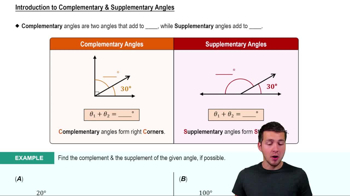
Complementary angles are two angles whose measures add up to 90 degrees. To find the complement of a given angle, subtract its measure from 90°. For example, the complement of a 35° angle is 90° - 35° = 55°.
Video consigliato:
Percorso guidato
3:35
Intro to Complementary & Supplementary Angles

Supplementary Angles

Supplementary angles are two angles whose measures add up to 180 degrees. To find the supplement of a given angle, subtract its measure from 180°. For instance, the supplement of a 35° angle is 180° - 35° = 145°.
Video consigliato:
Percorso guidato
3:35
Intro to Complementary & Supplementary Angles

Angle Measurement and Units

Angles are measured in degrees, representing the amount of rotation between two rays. Understanding how to manipulate and calculate with degrees is essential for solving problems involving complementary and supplementary angles.
Video consigliato:
Percorso guidato
5:31
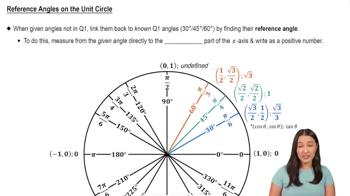
Reference Angles on the Unit Circle