Concept Check Suppose that the point (x, y) is in the indicated quadrant. Determine whether the given ratio is positive or negative. Recall that r = √(x² + y²) .(Hint: Drawing a sketch may help.) I , y/r
Ch. 1 - Trigonometric Functions
Lial12th EditionTrigonometryISBN: 9780136552161, 9780135440780, 9780136881117, 9780135440827, 9780135924891Non è quello che usi tu?Cambia libro di testo
Capitolo 2, Problema 46
Identify the quadrant (or possible quadrants) of an angle θ that satisfies the given conditions. See Example 3.
csc θ > 0 , cot θ > 0
Guida verificata passo dopo passo1
Recall the definitions and signs of the trigonometric functions in each quadrant. The cosecant function, \(\csc \theta\), is the reciprocal of sine, so \(\csc \theta = \frac{1}{\sin \theta}\). Therefore, \(\csc \theta > 0\) means \(\sin \theta > 0\).
Determine in which quadrants \(\sin \theta\) is positive. Since sine corresponds to the y-coordinate on the unit circle, \(\sin \theta > 0\) in Quadrant I and Quadrant II.
Next, analyze the condition \(\cot \theta > 0\). Recall that \(\cot \theta = \frac{\cos \theta}{\sin \theta}\). For \(\cot \theta\) to be positive, the ratio \(\frac{\cos \theta}{\sin \theta}\) must be positive, meaning \(\cos \theta\) and \(\sin \theta\) have the same sign.
Since from step 2, \(\sin \theta > 0\), for \(\cot \theta\) to be positive, \(\cos \theta\) must also be positive. Identify the quadrants where both \(\sin \theta\) and \(\cos \theta\) are positive.
Conclude that the angle \(\theta\) must lie in Quadrant I, where both sine and cosine are positive, satisfying both \(\csc \theta > 0\) and \(\cot \theta > 0\).

Risposta video verificata per un problema simile:
Questa soluzione video è stata consigliata dai nostri tutor come utile per risolvere questo problema.
Durata del video:
3mConcetti chiave
Ecco i concetti essenziali che devi comprendere per rispondere correttamente alla domanda.
Signs of Trigonometric Functions in Quadrants
The signs of sine, cosine, tangent, and their reciprocals vary depending on the quadrant of the angle. For example, sine and cosecant are positive in Quadrants I and II, while cotangent is positive in Quadrants I and III. Understanding these sign patterns helps determine the possible quadrants for an angle.
Video consigliato:
Percorso guidato
Quadratic Formula
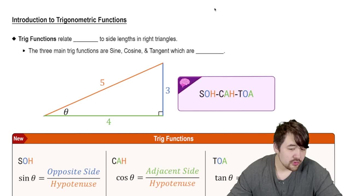
Reciprocal Trigonometric Functions
Cosecant (csc) is the reciprocal of sine (sin), and cotangent (cot) is the reciprocal of tangent (tan). Knowing these relationships allows you to infer the sign of sine and tangent from the signs of cosecant and cotangent, which is essential for identifying the correct quadrant.
Video consigliato:
Percorso guidato
Introduction to Trigonometric Functions
Quadrant Determination Using Multiple Conditions
When given multiple inequalities involving trigonometric functions, the solution involves finding the intersection of quadrants where all conditions hold true. This requires combining the sign information of each function to narrow down the possible quadrants for the angle θ.
Video consigliato:
Percorso guidato
Solving Quadratic Equations by the Square Root Property
Pratica correlata
Domanda del libro di testo
549
views
Domanda del libro di testo
Solve each problem. Height of a Lunar Peak The lunar mountain peak Huygens has a height of 21,000 ft. The shadow of Huygens on a photograph was 2.8 mm, while the nearby mountain Bradley had a shadow of 1.8 mm on the same photograph. Calculate the height of Bradley. (Data from Webb, T., Celestial Objects for Common Telescopes, Dover Publications.)
696
views
Domanda del libro di testo
Determine whether each statement is possible or impossible. c. cos θ = 5
804
views
Domanda del libro di testo
Determine whether each statement is possible or impossible. b. tan θ = 1.4
716
views
Domanda del libro di testo
Determine whether each statement is possible or impossible. a. sec θ = ―2/3
1103
views
Domanda del libro di testo
Perform each calculation. See Example 3. 90° ― 17° 13'
627
views