Ch. 1 - Trigonometric Functions
Lial - Trigonometry 12th Edition
Lial12th EditionTrigonometryISBN: 9780136552161, 9780135440780, 9780136881117, 9780135440827, 9780135924891Non è quello che usi tu?Cambia libro di testo
Capitolo 2, Problema 15

Sketch an angle θ in standard position such that θ has the least positive measure, and the given point is on the terminal side of θ. Then find the values of the six trigonometric functions for each angle. Rationalize denominators when applicable. See Examples 1, 2, and 4. (―8 , 15)

Guida verificata passo dopo passo
1
Step 1: Understand the problem. You are given a point (-8, 15) on the terminal side of an angle \( \theta \) in standard position. The goal is to sketch this angle and find the six trigonometric functions: sine, cosine, tangent, cosecant, secant, and cotangent for \( \theta \).
Step 2: Calculate the radius \( r \), which is the distance from the origin to the point \((-8, 15)\). Use the distance formula: \[ r = \sqrt{x^2 + y^2} = \sqrt{(-8)^2 + 15^2} \]
Step 3: Find the six trigonometric functions using the definitions based on the coordinates and radius: - \( \sin \theta = \frac{y}{r} \) - \( \cos \theta = \frac{x}{r} \) - \( \tan \theta = \frac{y}{x} \) - \( \csc \theta = \frac{r}{y} \) - \( \sec \theta = \frac{r}{x} \) - \( \cot \theta = \frac{x}{y} \)
Step 4: Determine the quadrant of the angle \( \theta \). Since \( x = -8 \) (negative) and \( y = 15 \) (positive), the point lies in the second quadrant. This helps understand the signs of the trigonometric functions.
Step 5: Rationalize denominators if any of the trigonometric function values have radicals in the denominator, and express all six functions in simplest form with correct signs based on the quadrant.

Risposta video verificata per un problema simile:

Questa soluzione video è stata consigliata dai nostri tutor come utile per risolvere questo problema.

Concetti chiave

Ecco i concetti essenziali che devi comprendere per rispondere correttamente alla domanda.

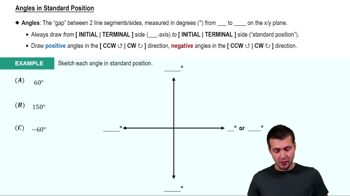
Standard Position of an Angle

An angle is in standard position when its vertex is at the origin of the coordinate plane and its initial side lies along the positive x-axis. The terminal side is determined by rotating the initial side counterclockwise by the angle measure θ. Sketching the angle involves plotting the given point on the terminal side and drawing the angle accordingly.
Video consigliato:
Percorso guidato
05:50
Drawing Angles in Standard Position

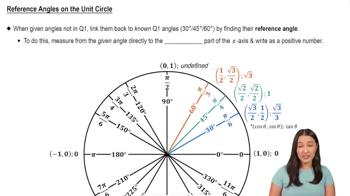
Finding the Reference Angle and Least Positive Angle

The least positive angle θ is the smallest positive rotation from the initial side to the terminal side that passes through the given point. To find θ, determine the quadrant of the point and calculate the angle using inverse trigonometric functions or the arctangent of y/x, adjusting for the correct quadrant to ensure the angle is positive and less than 360°.
Video consigliato:
Percorso guidato
5:31
Reference Angles on the Unit Circle

Six Trigonometric Functions from a Point on the Terminal Side

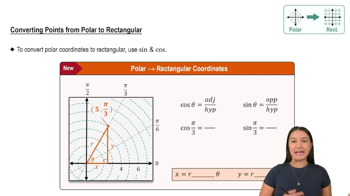
Given a point (x, y) on the terminal side, the six trigonometric functions—sine, cosine, tangent, cosecant, secant, and cotangent—can be found using the definitions: sin θ = y/r, cos θ = x/r, tan θ = y/x, where r = √(x² + y²). The reciprocal functions are cosecant = 1/sin θ, secant = 1/cos θ, and cotangent = 1/tan θ. Rationalizing denominators ensures simplified exact values.
Video consigliato:
Percorso guidato
06:17
Convert Points from Polar to Rectangular