Ch. 1 - Trigonometric Functions
Lial - Trigonometry 12th Edition
Lial12th EditionTrigonometryISBN: 9780136552161, 9780135440780, 9780136881117, 9780135440827, 9780135924891Non è quello che usi tu?Cambia libro di testo
Capitolo 2, Problema 6

Solve each problem. Rotating Pulley A pulley is rotating 320 times per min. Through how many degrees does a point on the edge of the pulley move in 2/3 sec?

Guida verificata passo dopo passo
1
Identify the given information: the pulley rotates 320 times per minute, and we want to find the degrees moved in \( \frac{2}{3} \) seconds.
Convert the rotation rate from revolutions per minute (rpm) to revolutions per second (rps) by dividing 320 by 60, since there are 60 seconds in a minute: \( \text{rps} = \frac{320}{60} \).
Calculate the number of revolutions the pulley makes in \( \frac{2}{3} \) seconds by multiplying the revolutions per second by \( \frac{2}{3} \): \( \text{revolutions} = \text{rps} \times \frac{2}{3} \).
Recall that one full revolution corresponds to 360 degrees. To find the total degrees moved, multiply the number of revolutions by 360: \( \text{degrees} = \text{revolutions} \times 360 \).
Combine all the steps into one expression if desired, but do not calculate the final numeric value as per instructions.

Risposta video verificata per un problema simile:

Questa soluzione video è stata consigliata dai nostri tutor come utile per risolvere questo problema.
Durata del video:
2m

Concetti chiave

Ecco i concetti essenziali che devi comprendere per rispondere correttamente alla domanda.

Angular Displacement

Angular displacement measures the angle through which a point or line has been rotated in a specified direction. It is usually expressed in degrees or radians and represents the change in angular position of a rotating object.

Conversion between Rotations and Degrees

One complete rotation corresponds to 360 degrees. To find the angular displacement in degrees, multiply the number of rotations by 360. This conversion is essential when relating rotational speed to angular displacement.
Video consigliato:
Percorso guidato
5:04
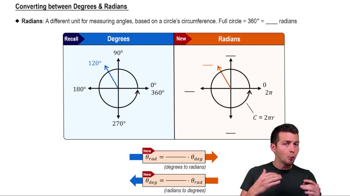
Converting between Degrees & Radians

Relating Rotational Speed to Time

Rotational speed given in rotations per minute (rpm) can be converted to rotations per second by dividing by 60. Multiplying this by the time interval in seconds gives the total rotations during that time, which can then be converted to angular displacement.
Video consigliato:
Percorso guidato
5:20
Introduction to Relations and Functions