
Ch. 1 - Trigonometric Functions
Lial - Trigonometry 12th Edition
Lial12th EditionTrigonometryISBN: 9780136552161, 9780135440780, 9780136881117, 9780135440827, 9780135924891Non è quello che usi tu?Cambia libro di testo
Capitolo 2, Problema 127

Solve each problem. See Example 6. Rotating Pulley A pulley rotates through 75° in 1 min. How many rotations does the pulley make in 1 hr?

Guida verificata passo dopo passo
1
Understand the problem: The pulley rotates through an angle of 75° in 1 minute, and we need to find how many full rotations it makes in 1 hour.
Recall that one full rotation corresponds to an angle of 360°. To find the number of rotations, we will convert the total angle rotated in 1 hour into the number of full 360° rotations.
Calculate the total angle rotated in 1 hour. Since 1 hour = 60 minutes, multiply the angle rotated per minute by 60: \(\text{Total angle} = 75^\circ \times 60\).
Find the number of full rotations by dividing the total angle rotated in 1 hour by 360°: \(\text{Number of rotations} = \frac{\text{Total angle}}{360^\circ}\).
Simplify the expression to get the number of rotations the pulley makes in 1 hour.

Risposta video verificata per un problema simile:

Questa soluzione video è stata consigliata dai nostri tutor come utile per risolvere questo problema.
Durata del video:
2m

Concetti chiave

Ecco i concetti essenziali che devi comprendere per rispondere correttamente alla domanda.

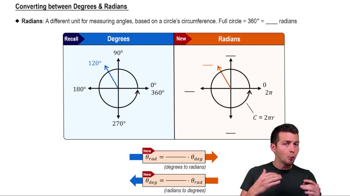
Angle Measurement in Degrees and Radians

Angles can be measured in degrees or radians, where 360° equals one full rotation. Understanding how to convert between degrees and rotations is essential for solving problems involving rotational motion.
Video consigliato:
Percorso guidato
5:04
Converting between Degrees & Radians

Relationship Between Angular Displacement and Rotations

Angular displacement refers to the angle through which an object rotates. One full rotation corresponds to 360°, so the number of rotations can be found by dividing the total angular displacement by 360°.
Video consigliato:
Percorso guidato
6:50
Convert Equations from Polar to Rectangular

Unit Conversion and Time Scaling

Converting time units (minutes to hours) and scaling angular displacement over time are crucial to determine total rotations over a given period. Multiplying the rotations per minute by the total minutes gives the total rotations.
Video consigliato:
Percorso guidato
06:11
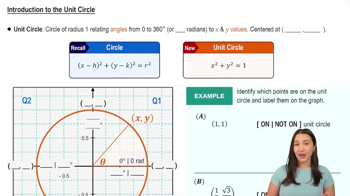
Introduction to the Unit Circle