Ch. 1 - Trigonometric Functions
Lial - Trigonometry 12th Edition
Lial12th EditionTrigonometryISBN: 9780136552161, 9780135440780, 9780136881117, 9780135440827, 9780135924891Non è quello che usi tu?Cambia libro di testo
Capitolo 2, Problema 91

Use trigonometric function values of quadrantal angles to evaluate each expression. (sin 180°)² + (cos 180°)²

Guida verificata passo dopo passo
1
Recall the Pythagorean identity in trigonometry: \(\sin^2 \theta + \cos^2 \theta = 1\) for any angle \(\theta\).
Identify the angle given in the problem, which is \(180^\circ\), a quadrantal angle lying on the negative x-axis.
Find the exact values of \(\sin 180^\circ\) and \(\cos 180^\circ\) using the unit circle: \(\sin 180^\circ = 0\) and \(\cos 180^\circ = -1\).
Substitute these values into the expression: \((\sin 180^\circ)^2 + (\cos 180^\circ)^2 = (0)^2 + (-1)^2\).
Simplify the expression by squaring each term and adding them together to verify the identity.

Risposta video verificata per un problema simile:

Questa soluzione video è stata consigliata dai nostri tutor come utile per risolvere questo problema.
Durata del video:
1m

Concetti chiave

Ecco i concetti essenziali che devi comprendere per rispondere correttamente alla domanda.

Quadrantal Angles

Quadrantal angles are angles that lie on the x- or y-axis in the coordinate plane, typically 0°, 90°, 180°, 270°, and 360°. Their sine and cosine values are either 0, 1, or -1, which simplifies calculations and helps evaluate trigonometric expressions easily.
Video consigliato:
Percorso guidato
6:36
Quadratic Formula

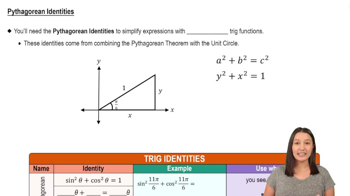
Pythagorean Identity

The Pythagorean identity states that for any angle θ, (sin θ)² + (cos θ)² = 1. This fundamental relationship holds true for all angles, including quadrantal angles, and is essential for verifying or simplifying trigonometric expressions.
Video consigliato:
Percorso guidato
6:25
Pythagorean Identities

Evaluating Trigonometric Functions at Specific Angles

Evaluating sine and cosine at specific angles involves substituting the angle into the function and using known values or the unit circle. For example, sin 180° = 0 and cos 180° = -1, which can be directly applied to simplify expressions.
Video consigliato:
Percorso guidato
3:48
Evaluate Composite Functions - Special Cases