Ch. 2 - Acute Angles and Right Triangles
Lial - Trigonometry 12th Edition
Lial12th EditionTrigonometryISBN: 9780136552161, 9780135440780, 9780136881117, 9780135440827, 9780135924891Non è quello che usi tu?Cambia libro di testo
Capitolo 3, Problema 7

Concept Check Match each angle in Column I with its reference angle in Column II. Choices may be used once, more than once, or not at all. See Example 1. I. II. 5. A. 45° 6. B. 60° 7. -135° C. 82° 8. D. 30° 9. E. 38° 10. F. 32°

Guida verificata passo dopo passo
1
Understand that the reference angle is the acute angle formed between the terminal side of the given angle and the x-axis. It is always between 0° and 90°.
For negative angles, first find the positive coterminal angle by adding 360° (i.e., \( \theta_{positive} = \theta_{negative} + 360^\circ \)).
Determine the quadrant of the positive angle to find the reference angle using these rules: - Quadrant I: reference angle = angle itself - Quadrant II: reference angle = 180° - angle - Quadrant III: reference angle = angle - 180° - Quadrant IV: reference angle = 360° - angle
Apply the above to the angle \(-135^\circ\): add 360° to get \(225^\circ\), which lies in Quadrant III, so reference angle = \(225^\circ - 180^\circ = 45^\circ\).
Match the calculated reference angle with the options in Column II, and repeat the process for other angles if given.

Risposta video verificata per un problema simile:

Questa soluzione video è stata consigliata dai nostri tutor come utile per risolvere questo problema.
Durata del video:
2m

Concetti chiave

Ecco i concetti essenziali che devi comprendere per rispondere correttamente alla domanda.

Reference Angle

A reference angle is the acute angle formed between the terminal side of a given angle and the x-axis. It is always positive and less than or equal to 90°, used to simplify trigonometric calculations by relating any angle to its acute counterpart.
Video consigliato:
Percorso guidato
5:31
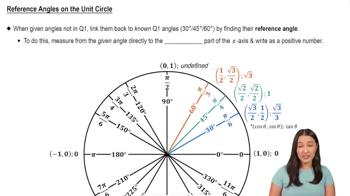
Reference Angles on the Unit Circle

Angle Measurement and Quadrants

Angles can be positive or negative and are measured from the positive x-axis, moving counterclockwise for positive angles and clockwise for negative ones. Understanding which quadrant an angle lies in helps determine the reference angle and the sign of trigonometric functions.
Video consigliato:
Percorso guidato
6:36
Quadratic Formula

Calculating Reference Angles for Negative Angles

For negative angles, the reference angle is found by adding the angle to 360° (or 2π radians) to find its positive coterminal angle, then determining the acute angle between this coterminal angle and the x-axis. This process ensures correct matching with the reference angle.
Video consigliato:
Percorso guidato
5:31
Reference Angles on the Unit Circle
Pratica correlata
Domanda del libro di testo

Match each trigonometric function in Column I with its value in Column II. Choices may be used once, more than once, or not at all.

cot 30°

446
views

Domanda del libro di testo

Concept Check Refer to the discussion of accuracy and significant digits in this section to answer the following. Mt. Everest When Mt. Everest was first surveyed, the surveyors obtained a height of 29,000 ft to the nearest foot. State the range represented by this number. (The surveyors thought no one would believe a measurement of 29,000 ft, so they reported it as 29,002.) (Data from Dunham, W., The Mathematical Universe, John Wiley and Sons.)

427
views
Domanda del libro di testo

Find one solution for each equation. Assume all angles involved are acute angles. cos(3θ + 11°) = sin( 7θ + 40°) 5 10

698
views
Domanda del libro di testo

Find exact values or expressions for sin A, cos A, and tan A. See Example 1.

1026
views
Domanda del libro di testo

CONCEPT PREVIEW Match each trigonometric function value or angle in Column I with its appropriate approximation in Column II.

Column I: 1.

scs 80°

Column II:

A. 88.09084757°

B. 63.25631605°

C. 1.909152433°

D. 17.45760312°

E. 0.2867453858

F. 1.962610506

G. 14.47751219°

H. 1.015426612

I. 1.051462224

J. 0.9925461516

581
views
Domanda del libro di testo

CONCEPT PREVIEW Match each trigonometric function value or angle in Column I with its appropriate approximation in Column II.

Column I: 1.

tan⁻¹ 30

Column II:

A. 88.09084757°

B. 63.25631605°

C. 1.909152433°

D. 17.45760312°

E. 0.2867453858

F. 1.962610506

G. 14.47751219°

H. 1.015426612

I. 1.051462224

J. 0.9925461516

584
views