Ch. 2 - Acute Angles and Right Triangles
Lial - Trigonometry 12th Edition
Lial12th EditionTrigonometryISBN: 9780136552161, 9780135440780, 9780136881117, 9780135440827, 9780135924891Non è quello che usi tu?Cambia libro di testo
Capitolo 3, Problema 27

Find exact values of the six trigonometric functions of each angle. Rationalize denominators when applicable. See Examples 2, 3, and 5. 1305°

Guida verificata passo dopo passo
1
Step 1: Since trigonometric functions are periodic, reduce the given angle 1305° to an equivalent angle between 0° and 360° by subtracting multiples of 360°. Calculate \(1305° - 3 \times 360°\) to find the reference angle.
Step 2: Determine the quadrant in which the reduced angle lies. This will help identify the signs (positive or negative) of the trigonometric functions based on the ASTC (All Students Take Calculus) rule.
Step 3: Find the reference angle, which is the acute angle formed with the x-axis. This is done by subtracting the reduced angle from the nearest x-axis angle (0°, 90°, 180°, 270°, or 360°) depending on the quadrant.
Step 4: Use the reference angle to find the exact values of the six trigonometric functions: sine, cosine, tangent, cosecant, secant, and cotangent. Use known exact values for standard angles or the unit circle.
Step 5: Apply the appropriate sign to each function based on the quadrant determined in Step 2, and rationalize denominators if any of the trigonometric values contain radicals in the denominator.

Risposta video verificata per un problema simile:

Questa soluzione video è stata consigliata dai nostri tutor come utile per risolvere questo problema.
Durata del video:
9m

Concetti chiave

Ecco i concetti essenziali che devi comprendere per rispondere correttamente alla domanda.

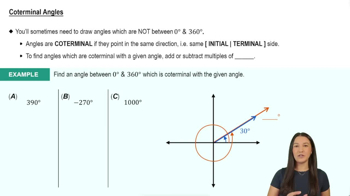
Coterminal Angles

Coterminal angles are angles that share the same terminal side when drawn in standard position. To find a coterminal angle between 0° and 360°, add or subtract multiples of 360° from the given angle. This helps simplify large angles like 1305° to an equivalent angle within one full rotation.
Video consigliato:
Percorso guidato
04:46
Coterminal Angles

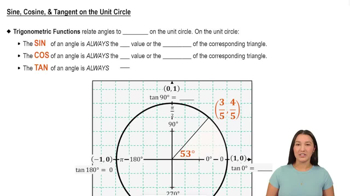
Trigonometric Function Values on the Unit Circle

The six trigonometric functions (sine, cosine, tangent, cosecant, secant, and cotangent) can be determined using the coordinates of points on the unit circle. Each angle corresponds to a point (x, y), where sine is y, cosine is x, and tangent is y/x. Understanding this relationship allows exact value calculation.
Video consigliato:
Percorso guidato
6:34
Sine, Cosine, & Tangent on the Unit Circle

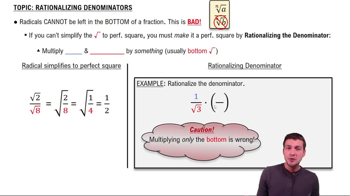
Rationalizing Denominators

Rationalizing denominators involves eliminating radicals from the denominator of a fraction by multiplying numerator and denominator by a suitable expression. This process is important for presenting trigonometric values in a simplified, standardized form, especially when exact values involve square roots.
Video consigliato:
Percorso guidato
2:58
Rationalizing Denominators