Ch. 2 - Acute Angles and Right Triangles
Lial - Trigonometry 12th Edition
Lial12th EditionTrigonometryISBN: 9780136552161, 9780135440780, 9780136881117, 9780135440827, 9780135924891Non è quello che usi tu?Cambia libro di testo
Capitolo 3, Problema 31

Find one solution for each equation. Assume all angles involved are acute angles. See Example 3. tan α = cot(α + 10°)

Guida verificata passo dopo passo
1
Recall the definition of cotangent in terms of tangent: \(\cot \theta = \frac{1}{\tan \theta}\). So, rewrite the equation \(\tan \alpha = \cot(\alpha + 10^\circ)\) as \(\tan \alpha = \frac{1}{\tan(\alpha + 10^\circ)}\).
Multiply both sides of the equation by \(\tan(\alpha + 10^\circ)\) to eliminate the fraction: \(\tan \alpha \cdot \tan(\alpha + 10^\circ) = 1\).
Use the tangent addition formula to express \(\tan(\alpha + 10^\circ)\) in terms of \(\tan \alpha\) and \(\tan 10^\circ\): \(\tan(\alpha + 10^\circ) = \frac{\tan \alpha + \tan 10^\circ}{1 - \tan \alpha \tan 10^\circ}\).
Substitute this expression back into the equation from step 2: \(\tan \alpha \cdot \frac{\tan \alpha + \tan 10^\circ}{1 - \tan \alpha \tan 10^\circ} = 1\).
Multiply both sides by the denominator to clear the fraction and then rearrange the resulting equation to form a quadratic equation in terms of \(\tan \alpha\). Solve this quadratic equation to find possible values of \(\tan \alpha\), and then determine \(\alpha\) by taking the arctangent, considering that \(\alpha\) is an acute angle.

Risposta video verificata per un problema simile:

Questa soluzione video è stata consigliata dai nostri tutor come utile per risolvere questo problema.

Concetti chiave

Ecco i concetti essenziali che devi comprendere per rispondere correttamente alla domanda.

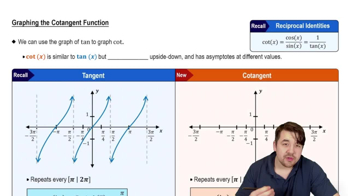
Relationship Between Tangent and Cotangent

Tangent and cotangent are reciprocal trigonometric functions, where tan(θ) = 1/cot(θ). Understanding that cotangent of an angle can be expressed as the tangent of its complement, cot(θ) = tan(90° - θ), helps in rewriting and solving equations involving both functions.
Video consigliato:
Percorso guidato
5:37
Introduction to Cotangent Graph

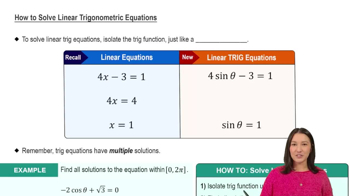
Solving Trigonometric Equations

Solving trigonometric equations involves manipulating the equation using identities and algebraic techniques to isolate the variable. Recognizing equivalent expressions and applying inverse functions or angle relationships is essential to find valid angle solutions within given constraints.
Video consigliato:
Percorso guidato
4:34
How to Solve Linear Trigonometric Equations

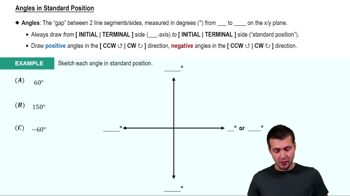
Acute Angle Constraints

When angles are restricted to acute angles (0° < angle < 90°), solutions must be checked to ensure they fall within this range. This constraint limits possible solutions and affects how inverse trigonometric functions are applied, ensuring the final answer is valid in the given context.
Video consigliato:
Percorso guidato
05:50
Drawing Angles in Standard Position