Ch. 2 - Acute Angles and Right Triangles
Lial - Trigonometry 12th Edition
Lial12th EditionTrigonometryISBN: 9780136552161, 9780135440780, 9780136881117, 9780135440827, 9780135924891Non è quello che usi tu?Cambia libro di testo
Capitolo 3, Problema 48

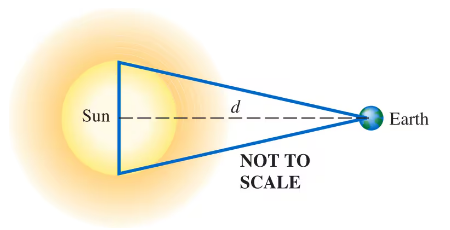
Solve each problem. See Examples 1–4. Diameter of the Sun To determine the diameter of the sun, an astronomer might sight with a transit (a device used by surveyors for measuring angles) first to one edge of the sun and then to the other, estimating that the included angle equals 32'. Assuming that the distance d from Earth to the sun is 92,919,800 mi, approximate the diameter of the sun.

Guida verificata passo dopo passo
1
Understand the problem: The astronomer measures the angle subtended by the diameter of the sun from Earth, which is given as 32 minutes of arc (32'). The goal is to find the actual diameter of the sun using this angle and the distance from Earth to the sun.
Convert the angle from minutes to degrees because trigonometric functions typically use degrees or radians. Since 1 degree = 60 minutes, the angle in degrees is \(\theta = \frac{32}{60}\) degrees.
Recognize that the angle \(\theta\) is very small and subtended by the diameter of the sun at distance \(d\). We can model this situation as an isosceles triangle where the sun's diameter is the base opposite the angle \(\theta\) at the observer's point.
Use the small-angle approximation or the formula relating arc length to radius and angle in radians. First, convert the angle \(\theta\) to radians: \(\theta_{rad} = \theta \times \frac{\pi}{180}\). Then, the diameter \(D\) of the sun can be approximated by \(D = d \times \theta_{rad}\), where \(d\) is the distance to the sun.
Substitute the given distance \(d = 92,919,800\) miles and the angle in radians into the formula to find the diameter \(D\). This will give the approximate diameter of the sun.

Risposta video verificata per un problema simile:

Questa soluzione video è stata consigliata dai nostri tutor come utile per risolvere questo problema.
Durata del video:
7m

Concetti chiave

Ecco i concetti essenziali che devi comprendere per rispondere correttamente alla domanda.

Angular Measurement in Degrees and Minutes

Angles can be measured in degrees, minutes, and seconds, where 1 degree equals 60 minutes. In this problem, the angle between the two edges of the sun is given as 32 minutes (32'), which must be converted to degrees or radians for calculations involving trigonometric functions or arc length.
Video consigliato:
Percorso guidato
5:04
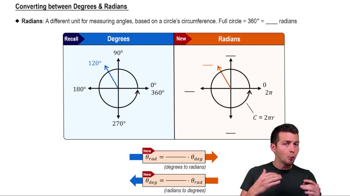
Converting between Degrees & Radians

Arc Length and Circle Geometry

The diameter of the sun can be approximated by treating the sun as an arc subtending a small angle at the observer's eye. Using the formula for arc length (arc length = radius × angle in radians), the diameter corresponds to the arc length formed by the angle measured from Earth, with the radius being the distance to the sun.
Video consigliato:
Percorso guidato
05:29
Adding Vectors Geometrically

Angle Conversion to Radians

Trigonometric calculations involving arc length require the angle to be in radians. To convert from degrees or minutes to radians, use the conversion factor π radians = 180 degrees. This step is essential to accurately compute the sun's diameter from the given angular measurement.
Video consigliato:
Percorso guidato
5:04
Converting between Degrees & Radians