Ch. 2 - Acute Angles and Right Triangles
Lial - Trigonometry 12th Edition
Lial12th EditionTrigonometryISBN: 9780136552161, 9780135440780, 9780136881117, 9780135440827, 9780135924891Non è quello che usi tu?Cambia libro di testo
Capitolo 3, Problema 2.5.25

Solve each problem. See Examples 1 and 2. Distance between Two Ships A ship leaves its home port and sails on a bearing of S 61°50'. Another ship leaves the same port at the same time and sails on a bearing of N 28°10'E. If the first ship sails at 24.0 mph and the second sails at 28.0 mph, find the distance between the two ships after 4 hr.

Guida verificata passo dopo passo
1
Convert the bearings into standard angles measured counterclockwise from the positive x-axis (East). For the first ship with bearing S 61°50', this corresponds to an angle of 180° + 61°50' (since it's measured clockwise from North to South), so calculate the exact angle in degrees. For the second ship with bearing N 28°10' E, this corresponds to an angle of 90° - 28°10' (since it's measured clockwise from North to East), so calculate this angle as well.
Calculate the distance each ship has traveled after 4 hours by multiplying their speeds by time: Distance = Speed × Time. For the first ship, multiply 24.0 mph by 4 hours; for the second ship, multiply 28.0 mph by 4 hours.
Express the position of each ship in Cartesian coordinates (x, y) using their distances and angles. Use the formulas: \(x = r \times \cos(\theta)\) and \(y = r \times \sin(\theta)\), where \(r\) is the distance traveled and \(\theta\) is the angle in radians (convert degrees to radians).
Find the difference in the x-coordinates and y-coordinates between the two ships to get the components of the vector representing the distance between them: \(\Delta x = x_2 - x_1\) and \(\Delta y = y_2 - y_1\).
Use the Pythagorean theorem to find the distance between the two ships: \(\text{Distance} = \sqrt{(\Delta x)^2 + (\Delta y)^2}\). This will give the straight-line distance between the ships after 4 hours.

Risposta video verificata per un problema simile:

Questa soluzione video è stata consigliata dai nostri tutor come utile per risolvere questo problema.
Durata del video:
4m

Concetti chiave

Ecco i concetti essenziali che devi comprendere per rispondere correttamente alla domanda.

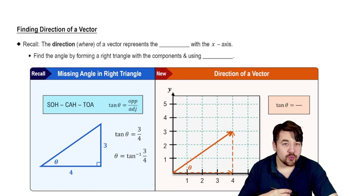
Bearing and Direction in Navigation

Bearing is a way to describe direction using angles measured clockwise from the north or south line. Bearings like S 61°50' mean starting from south and rotating 61°50' towards the east. Understanding how to convert these bearings into standard angles or vectors is essential for plotting the ships' courses accurately.
Video consigliato:
Percorso guidato
05:13
Finding Direction of a Vector

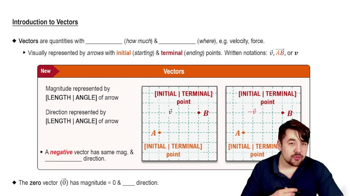
Vector Representation of Displacement

Each ship's movement can be represented as a vector based on its speed, time traveled, and direction (bearing). Calculating the displacement vectors allows us to find the ships' positions relative to the port after 4 hours, which is necessary to determine the distance between them.
Video consigliato:
Percorso guidato
03:48
Introduction to Vectors

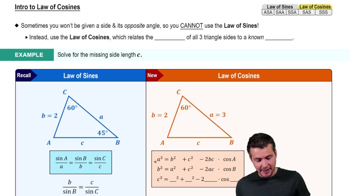
Law of Cosines for Distance Calculation

When two vectors form an angle, the distance between their endpoints can be found using the Law of Cosines. This law relates the lengths of two sides of a triangle and the included angle to find the third side, which in this problem is the distance between the two ships after traveling.
Video consigliato:
Percorso guidato
4:35
Intro to Law of Cosines