Ch. 2 - Acute Angles and Right Triangles
Lial - Trigonometry 12th Edition
Lial12th EditionTrigonometryISBN: 9780136552161, 9780135440780, 9780136881117, 9780135440827, 9780135924891Non è quello che usi tu?Cambia libro di testo
Capitolo 3, Problema 2.3.48

Use a calculator to evaluate each expression. 2 sin 25°13' cos 25°13' - sin 50°26'

Guida verificata passo dopo passo
1
First, recognize that the angles are given in degrees and minutes. Convert the angle 25°13' into decimal degrees if needed, or use the angle directly in your calculator by inputting degrees and minutes appropriately.
Recall the double-angle identity for sine: \(\sin(2\theta) = 2 \sin \theta \cos \theta\). Notice that the expression \(2 \sin 25°13' \cos 25°13'\) matches the left side of this identity with \(\theta = 25°13'\).
Rewrite the expression \(2 \sin 25°13' \cos 25°13'\) as \(\sin(2 \times 25°13')\), which simplifies to \(\sin 50°26'\).
Substitute this back into the original expression to get \(\sin 50°26' - \sin 50°26'\).
Since the two terms are the same, their difference is zero. This shows the expression simplifies to zero without needing further calculation.

Risposta video verificata per un problema simile:

Questa soluzione video è stata consigliata dai nostri tutor come utile per risolvere questo problema.
Durata del video:
2m

Concetti chiave

Ecco i concetti essenziali che devi comprendere per rispondere correttamente alla domanda.

Trigonometric Functions and Their Values

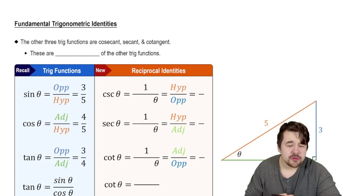
Sine and cosine are fundamental trigonometric functions that relate angles to ratios of sides in a right triangle. Understanding how to evaluate these functions for given angles, including those expressed in degrees and minutes, is essential for solving the expression.
Video consigliato:
Percorso guidato
6:04
Introduction to Trigonometric Functions

Angle Conversion and Notation

Angles given in degrees and minutes (e.g., 25°13') must be accurately interpreted or converted to decimal degrees for calculator input. One minute equals 1/60 of a degree, so converting ensures precise evaluation of trigonometric functions.
Video consigliato:

Trigonometric Identities

The expression involves terms like 2 sin A cos A and sin 2A, which are connected by the double-angle identity: sin 2A = 2 sin A cos A. Recognizing and applying this identity simplifies the expression and aids in verifying the result.
Video consigliato:
Percorso guidato
5:32
Fundamental Trigonometric Identities
Pratica correlata
Domanda del libro di testo

Find a value of θ in the interval [0°, 90°) that satisfies each statement. Give answers in decimal degrees to six decimal places. See Example 2.

tan θ = 6.4358841

614
views

Domanda del libro di testo

Use a calculator to approximate the value of each expression. Give answers to six decimal places. In Exercises 21–28, simplify the expression before using the calculator. See Example 1. cot 183° 48'

650
views
Domanda del libro di testo

CONCEPT PREVIEW Match each trigonometric function value or angle in Column I with its appropriate approximation in Column II.


Column I: 1.

csc⁻¹ 4

Column II:

A. 88.09084757°

B. 63.25631605°

C. 1.909152433°

D. 17.45760312°

E. 0.2867453858

F. 1.962610506

G. 14.47751219°

H. 1.015426612

I. 1.051462224

J. 0.9925461516

582
views
Domanda del libro di testo

CONCEPT PREVIEW Match the measure of bearing in Column I with the appropriate graph in Column II.

I. S 70° W


II. 1. A. B. C. 2. S 70° W 3. 4. D. E. F. 5. 6. 7. G. H. 8. 9. 10. I. J.

720
views
Domanda del libro di testo

Find a value of θ in the interval [0°, 90°) that satisfies each statement. Give answers in decimal degrees to six decimal places. See Example 2.

csc θ = 1.3861147

697
views
Domanda del libro di testo

(Modeling) Length of a Sag Curve When a highway goes downhill and then uphill, it has a sag curve. Sag curves are designed so that at night, headlights shine sufficiently far down the road to allow a safe stopping distance. See the figure. S and L are in feet. The minimum length L of a sag curve is determined by the height h of the car's headlights above the pavement, the downhill grade θ₁ < 0°, the uphill grade θ₂ > 0°, and the safe stopping distance S for a given speed limit. In addition, L is dependent on the vertical alignment of the headlights. Headlights are usually pointed upward at a slight angle α above the horizontal of the car. Using these quantities, for a 55 mph speed limit, L can be modeled by the formula (θ₂ - θ₁)S² L = ————————— , 200(h + S tan α) where S < L. (Data from Mannering, F., and W. Kilareski, Principles of Highway Engineering and Traffic Analysis, Second Edition, John Wiley and Sons.) Compute length L, to the nearest foot, if h = 1.9 ft, α = 0.9°, θ₁ = -3°, θ₂ = 4°, and S = 336 ft.

621
views