Ch. 3 - Radian Measure and The Unit Circle
Lial - Trigonometry 12th Edition
Lial12th EditionTrigonometryISBN: 9780136552161, 9780135440780, 9780136881117, 9780135440827, 9780135924891Non è quello che usi tu?Cambia libro di testo
Capitolo 4, Problema 55

Without using a calculator, decide whether each function value is positive or negative. (Hint: Consider the radian measures of the quadrantal angles, and remember that π ≈ 3.14.)


cos 2

Guida verificata passo dopo passo
1
Identify the angle given in radians, which is 2 radians in this case.
Recall that \( \pi \approx 3.14 \), so 2 radians is less than \( \pi \) but greater than \( \frac{\pi}{2} \) (approximately 1.57). This means the angle lies in the second quadrant of the unit circle.
Remember the signs of cosine in each quadrant: cosine is positive in the first and fourth quadrants, and negative in the second and third quadrants.
Since 2 radians is in the second quadrant, where cosine values are negative, conclude that \( \cos 2 \) is negative.
Thus, without calculating the exact value, you can determine the sign of \( \cos 2 \) by understanding the position of the angle on the unit circle.

Risposta video verificata per un problema simile:

Questa soluzione video è stata consigliata dai nostri tutor come utile per risolvere questo problema.

Concetti chiave

Ecco i concetti essenziali che devi comprendere per rispondere correttamente alla domanda.

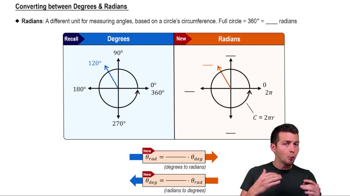
Understanding Radian Measure and Quadrantal Angles

Radian measure relates angles to the radius of a circle, where π radians equal 180°. Quadrantal angles are multiples of π/2 (90°), dividing the unit circle into four quadrants. Knowing where an angle lies helps determine the sign of trigonometric functions without a calculator.
Video consigliato:
Percorso guidato
5:04
Converting between Degrees & Radians

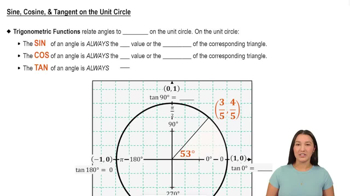
Unit Circle and Sign of Trigonometric Functions

The unit circle defines sine and cosine values based on coordinates of points on the circle. Cosine corresponds to the x-coordinate, which is positive in the first and fourth quadrants and negative in the second and third. Identifying the quadrant of the angle 2 radians helps decide the sign of cos 2.
Video consigliato:
Percorso guidato
6:34
Sine, Cosine, & Tangent on the Unit Circle

Approximation of π and Angle Location

Knowing π ≈ 3.14 allows estimation of where 2 radians lies on the unit circle. Since 2 is less than π (3.14) but greater than π/2 (1.57), the angle is in the second quadrant. This approximation is crucial to determine the sign of cosine without exact calculation.
Video consigliato:
Percorso guidato
04:46
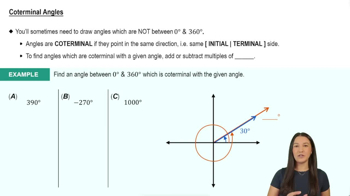
Coterminal Angles