Ch. 3 - Radian Measure and The Unit Circle
Lial - Trigonometry 12th Edition
Lial12th EditionTrigonometryISBN: 9780136552161, 9780135440780, 9780136881117, 9780135440827, 9780135924891Non è quello che usi tu?Cambia libro di testo
Capitolo 4, Problema 83

For each value of s, use a calculator to find sin s and cos s, and then use the results to decide in which quadrant an angle of s radians lies.
s = 51

Guida verificata passo dopo passo
1
Understand that the angle given is in radians, and since \(s = 51\) radians is quite large, the first step is to reduce this angle to an equivalent angle between \(0\) and \(2\pi\) radians by finding its remainder when divided by \(2\pi\). This is done using the formula: \(s_{\text{reduced}} = s \mod 2\pi\).
Calculate \(\sin s_{\text{reduced}}\) and \(\cos s_{\text{reduced}}\) using a calculator. These values will help determine the quadrant of the angle because the signs of sine and cosine vary by quadrant.
Recall the sign rules for sine and cosine in each quadrant: - Quadrant I: \(\sin > 0\), \(\cos > 0\) - Quadrant II: \(\sin > 0\), \(\cos < 0\) - Quadrant III: \(\sin < 0\), \(\cos < 0\) - Quadrant IV: \(\sin < 0\), \(\cos > 0\)
Compare the signs of the calculated \(\sin s_{\text{reduced}}\) and \(\cos s_{\text{reduced}}\) to the sign rules above to identify the quadrant in which the angle lies.
Summarize the result by stating the quadrant based on the signs of sine and cosine for the reduced angle.

Risposta video verificata per un problema simile:

Questa soluzione video è stata consigliata dai nostri tutor come utile per risolvere questo problema.

Concetti chiave

Ecco i concetti essenziali che devi comprendere per rispondere correttamente alla domanda.

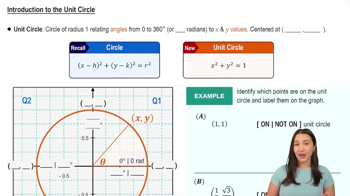
Unit Circle and Angle Measurement in Radians

The unit circle is a circle with radius 1 centered at the origin, used to define sine and cosine for all angles. Angles measured in radians correspond to arc lengths on this circle, where 2π radians equal 360°. Understanding how large angles like 51 radians wrap around the circle is essential to determine their position.
Video consigliato:
Percorso guidato
06:11
Introduction to the Unit Circle

Sine and Cosine Functions

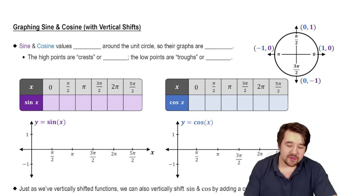
Sine and cosine are trigonometric functions that give the y- and x-coordinates, respectively, of a point on the unit circle corresponding to an angle. Their values range between -1 and 1 and vary periodically, which helps identify the angle's quadrant based on the signs of sin s and cos s.
Video consigliato:
Percorso guidato
5:53
Graph of Sine and Cosine Function

Quadrants and Sign of Trigonometric Functions

The coordinate plane is divided into four quadrants, each with specific signs for sine and cosine: Quadrant I (+,+), II (+,-), III (-,-), and IV (-,+). By evaluating the signs of sin s and cos s, one can determine the quadrant where the angle s lies, even for angles greater than 2π radians.
Video consigliato:
Percorso guidato
6:36
Quadratic Formula