Ch. 4 - Graphs of the Circular Functions
Lial - Trigonometry 12th Edition
Lial12th EditionTrigonometryISBN: 9780136552161, 9780135440780, 9780136881117, 9780135440827, 9780135924891Non è quello che usi tu?Cambia libro di testo
Capitolo 5, Problema 43

Determine the simplest form of an equation for each graph. Choose b > 0, and include no phase shifts. (Midpoints and quarter points are identified by dots.)


<IMAGE>

Guida verificata passo dopo passo
1
Identify the type of trigonometric function represented by the graph (sine or cosine) by observing the starting point of the graph at x = 0. For example, if the graph starts at the midline going upward, it is likely a sine function; if it starts at a maximum or minimum, it is likely a cosine function.
Determine the amplitude (a) by measuring the vertical distance from the midline (horizontal center line) to the maximum or minimum point of the graph.
Find the period (T) by measuring the horizontal length of one complete cycle of the graph. Use the formula for the period of sine or cosine: \(T = \frac{2\pi}{b}\), and solve for \(b\) as \(b = \frac{2\pi}{T}\).
Since the problem specifies no phase shifts, set the phase shift \(c = 0\). Write the general form of the function as \(y = a \sin(bx)\) or \(y = a \cos(bx)\) depending on the function type identified in step 1.
Verify the function by checking key points such as midpoints and quarter points (where the function reaches zero, maximum, or minimum) to ensure the equation matches the graph's behavior without any horizontal shifts.

Risposta video verificata per un problema simile:

Questa soluzione video è stata consigliata dai nostri tutor come utile per risolvere questo problema.

Concetti chiave

Ecco i concetti essenziali che devi comprendere per rispondere correttamente alla domanda.

Trigonometric Function Forms

Understanding the standard forms of sine and cosine functions, such as y = a sin(bx) or y = a cos(bx), is essential. These forms include amplitude (a), frequency (b), and phase shift, which define the shape and position of the graph. Recognizing these helps in writing the equation from the graph.
Video consigliato:
Percorso guidato
6:04
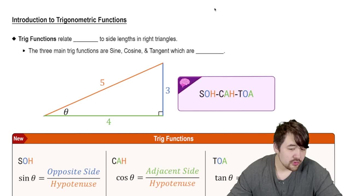
Introduction to Trigonometric Functions

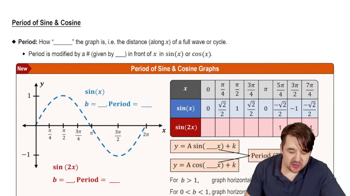
Amplitude and Period

Amplitude is the height from the midline to the peak of the wave, indicating the value of 'a'. The period is the length of one complete cycle, calculated as 2π divided by the frequency 'b'. Identifying these from the graph allows determination of 'a' and 'b' in the equation.
Video consigliato:
Percorso guidato
5:33
Period of Sine and Cosine Functions

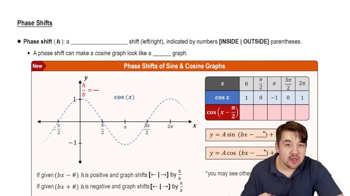
Phase Shift and Midline

Phase shift refers to horizontal shifts of the graph, but the question specifies no phase shifts, simplifying the equation. The midline is the horizontal axis around which the function oscillates, usually y=0 unless shifted vertically. Recognizing these helps in writing the simplest form without additional shifts.
Video consigliato: