Ch. 4 - Graphs of the Circular Functions
Lial - Trigonometry 12th Edition
Lial12th EditionTrigonometryISBN: 9780136552161, 9780135440780, 9780136881117, 9780135440827, 9780135924891Non è quello che usi tu?Cambia libro di testo
Capitolo 5, Problema 4.25

Graph each function over a one-period interval.
y = 1 - (1/2) csc (x - 3π/4)

Guida verificata passo dopo passo
1
Identify the basic form of the cosecant function: \( y = a + b \cdot \csc(c(x - d)) \). In this case, \( a = 1 \), \( b = -\frac{1}{2} \), \( c = 1 \), and \( d = \frac{3\pi}{4} \).
Determine the period of the function. The period of \( \csc(x) \) is \( 2\pi \), so the period of \( \csc(c(x - d)) \) is \( \frac{2\pi}{c} = 2\pi \).
Identify the phase shift, which is determined by \( d \). The function is shifted to the right by \( \frac{3\pi}{4} \).
Determine the vertical shift and reflection. The function is shifted up by 1 unit and reflected vertically due to the negative sign in front of \( \frac{1}{2} \).
Graph the function by plotting key points and asymptotes over one period, considering the transformations: vertical shift, reflection, and phase shift.

Risposta video verificata per un problema simile:

Questa soluzione video è stata consigliata dai nostri tutor come utile per risolvere questo problema.

Concetti chiave

Ecco i concetti essenziali che devi comprendere per rispondere correttamente alla domanda.

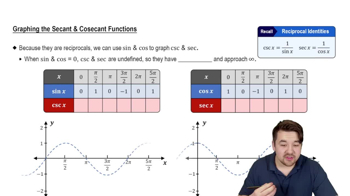
Cosecant Function

The cosecant function, denoted as csc(x), is the reciprocal of the sine function. It is defined as csc(x) = 1/sin(x). The cosecant function has a range of all real numbers except for the interval (-1, 1) and is undefined where sin(x) = 0. Understanding its properties, including its vertical asymptotes and periodicity, is essential for graphing functions involving csc.
Video consigliato:
Percorso guidato
6:22
Graphs of Secant and Cosecant Functions

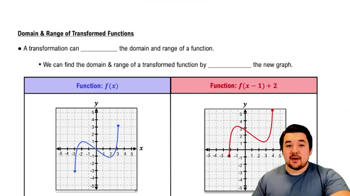
Transformations of Functions

Transformations of functions involve shifting, stretching, compressing, or reflecting the graph of a function. In the given function, y = 1 - (1/2) csc(x - 3π/4), the term (x - 3π/4) indicates a horizontal shift to the right by 3π/4, while the coefficient -1/2 affects the vertical stretch and reflection. Recognizing these transformations is crucial for accurately graphing the function.
Video consigliato:
Percorso guidato
4:22
Domain and Range of Function Transformations

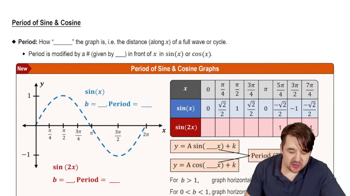
Period of Trigonometric Functions

The period of a trigonometric function is the length of one complete cycle of the function. For the cosecant function, the standard period is 2π. However, transformations can alter the period; in this case, since there are no horizontal scaling factors, the period remains 2π. Understanding the period helps in determining the intervals over which to graph the function accurately.
Video consigliato:
Percorso guidato
5:33
Period of Sine and Cosine Functions