Ch. 5 - Trigonometric Identities
Lial - Trigonometry 12th Edition
Lial12th EditionTrigonometryISBN: 9780136552161, 9780135440780, 9780136881117, 9780135440827, 9780135924891Non è quello che usi tu?Cambia libro di testo
Capitolo 6, Problema 5.40

Each expression simplifies to a constant, a single function, or a power of a function. Use fundamental identities to simplify each expression.
csc² t - 1

Guida verificata passo dopo passo
1
Recognize that the expression \( \csc^2 t - 1 \) can be related to a fundamental trigonometric identity.
Recall the Pythagorean identity: \( \csc^2 t = 1 + \cot^2 t \).
Substitute \( \csc^2 t \) in the expression with \( 1 + \cot^2 t \) to get \( (1 + \cot^2 t) - 1 \).
Simplify the expression by subtracting 1: \( \cot^2 t \).
Conclude that the simplified expression is \( \cot^2 t \), which is a power of a trigonometric function.

Risposta video verificata per un problema simile:

Questa soluzione video è stata consigliata dai nostri tutor come utile per risolvere questo problema.

Concetti chiave

Ecco i concetti essenziali che devi comprendere per rispondere correttamente alla domanda.

Cosecant Function

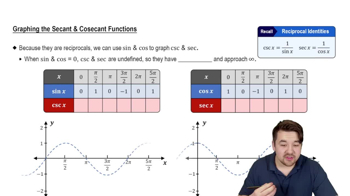
The cosecant function, denoted as csc(t), is the reciprocal of the sine function. It is defined as csc(t) = 1/sin(t). Understanding this function is crucial for simplifying expressions involving csc²(t), as it relates directly to the sine function and its properties.
Video consigliato:
Percorso guidato
6:22
Graphs of Secant and Cosecant Functions

Pythagorean Identity

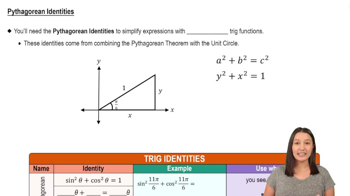
The Pythagorean identities are fundamental relationships in trigonometry that relate the squares of the sine and cosine functions. One key identity is sin²(t) + cos²(t) = 1. This identity can be rearranged to express csc²(t) in terms of sin²(t), which is essential for simplifying expressions like csc²(t) - 1.
Video consigliato:
Percorso guidato
6:25
Pythagorean Identities

Fundamental Trigonometric Identities

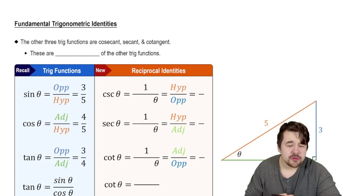
Fundamental trigonometric identities are equations involving trigonometric functions that are true for all values of the variable where the functions are defined. These include reciprocal identities, Pythagorean identities, and co-function identities. Utilizing these identities allows for the simplification of complex trigonometric expressions into more manageable forms.
Video consigliato:
Percorso guidato
5:32
Fundamental Trigonometric Identities