Ch. 5 - Trigonometric Identities
Lial - Trigonometry 12th Edition
Lial12th EditionTrigonometryISBN: 9780136552161, 9780135440780, 9780136881117, 9780135440827, 9780135924891Non è quello che usi tu?Cambia libro di testo
Capitolo 6, Problema 5.1.66

Write each expression in terms of sine and cosine, and then simplify the expression so that no quotients appear and all functions are of θ only. See Example 3.
[1 - sin²(-θ)]/[1 + cot²(-θ)]

Guida verificata passo dopo passo
1
Recall the Pythagorean identity: \(\sin^2(\theta) + \cos^2(\theta) = 1\). This will help simplify expressions involving \(1 - \sin^2(\theta)\).
Rewrite the numerator \(1 - \sin^2(-\theta)\) using the identity. Since \(\sin(-\theta) = -\sin(\theta)\), we have \(\sin^2(-\theta) = \sin^2(\theta)\), so the numerator becomes \(1 - \sin^2(\theta)\).
Rewrite the denominator \(1 + \cot^2(-\theta)\). Recall that \(\cot(\theta) = \frac{\cos(\theta)}{\sin(\theta)}\) and \(\cot(-\theta) = -\cot(\theta)\), so \(\cot^2(-\theta) = \cot^2(\theta)\). Use the Pythagorean identity \(1 + \cot^2(\theta) = \csc^2(\theta)\) to rewrite the denominator.
Express \(\csc(\theta)\) in terms of sine: \(\csc(\theta) = \frac{1}{\sin(\theta)}\), so \(\csc^2(\theta) = \frac{1}{\sin^2(\theta)}\). Substitute this into the denominator.
Combine the simplified numerator and denominator: \(\frac{1 - \sin^2(\theta)}{\frac{1}{\sin^2(\theta)}}\). Then rewrite \(1 - \sin^2(\theta)\) as \(\cos^2(\theta)\) and multiply by the reciprocal of the denominator to eliminate the fraction, resulting in an expression involving only sine and cosine with no quotients.

Risposta video verificata per un problema simile:

Questa soluzione video è stata consigliata dai nostri tutor come utile per risolvere questo problema.

Concetti chiave

Ecco i concetti essenziali che devi comprendere per rispondere correttamente alla domanda.

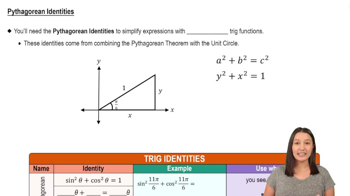
Pythagorean Identities

Pythagorean identities relate sine and cosine functions, such as sin²θ + cos²θ = 1. These identities allow rewriting expressions involving squares of sine or cosine in simpler forms, which is essential for simplifying trigonometric expressions without quotients.
Video consigliato:
Percorso guidato
6:25
Pythagorean Identities

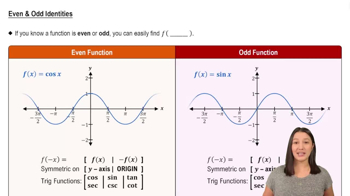
Even-Odd Properties of Trigonometric Functions

Even-odd properties describe how trig functions behave under negation of the angle: sine and cotangent are odd functions (f(-θ) = -f(θ)), while cosine is even (f(-θ) = f(θ)). Recognizing these helps simplify expressions involving negative angles by rewriting them in terms of positive angles.
Video consigliato:
Percorso guidato
06:19
Even and Odd Identities

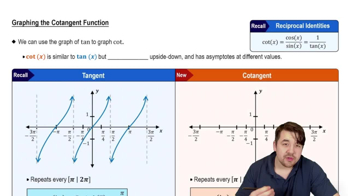
Definition and Conversion of Cotangent

Cotangent is defined as cot θ = cos θ / sin θ. To eliminate quotients, cotangent expressions can be rewritten using sine and cosine, enabling simplification into forms involving only sine and cosine without fractions.
Video consigliato:
Percorso guidato
5:37
Introduction to Cotangent Graph