Ch. 5 - Trigonometric Identities
Lial - Trigonometry 12th Edition
Lial12th EditionTrigonometryISBN: 9780136552161, 9780135440780, 9780136881117, 9780135440827, 9780135924891Non è quello che usi tu?Cambia libro di testo
Capitolo 6, Problema 14

Find values of the sine and cosine functions for each angle measure.


θ, given cos 2θ = 3/4 and θ terminates in quadrant III

Guida verificata passo dopo passo
1
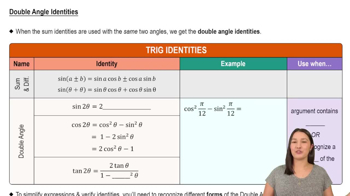
Recall the double-angle identity for cosine: \(\cos 2\theta = 2\cos^2 \theta - 1\). This relates \(\cos 2\theta\) to \(\cos \theta\).
Substitute the given value \(\cos 2\theta = \frac{3}{4}\) into the identity: \(\frac{3}{4} = 2\cos^2 \theta - 1\).
Solve the equation for \(\cos^2 \theta\): add 1 to both sides to get \(\frac{3}{4} + 1 = 2\cos^2 \theta\), which simplifies to \(\frac{7}{4} = 2\cos^2 \theta\). Then divide both sides by 2 to find \(\cos^2 \theta = \frac{7}{8}\).
Take the square root of both sides to find \(\cos \theta = \pm \sqrt{\frac{7}{8}}\). Since \(\theta\) terminates in quadrant III, where cosine is negative, choose the negative root: \(\cos \theta = -\sqrt{\frac{7}{8}}\).
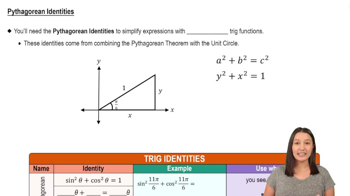
Use the Pythagorean identity \(\sin^2 \theta + \cos^2 \theta = 1\) to find \(\sin \theta\). Substitute \(\cos^2 \theta = \frac{7}{8}\) to get \(\sin^2 \theta = 1 - \frac{7}{8} = \frac{1}{8}\). Then \(\sin \theta = \pm \sqrt{\frac{1}{8}}\). Since \(\theta\) is in quadrant III, where sine is negative, choose the negative root: \(\sin \theta = -\sqrt{\frac{1}{8}}\).

Risposta video verificata per un problema simile:

Questa soluzione video è stata consigliata dai nostri tutor come utile per risolvere questo problema.

Concetti chiave

Ecco i concetti essenziali che devi comprendere per rispondere correttamente alla domanda.

Double-Angle Identity for Cosine

The double-angle identity states that cos(2θ) = 2cos²(θ) - 1 or cos(2θ) = 1 - 2sin²(θ). This identity allows us to express cos(2θ) in terms of either sine or cosine of θ, which is essential for finding sin(θ) and cos(θ) when cos(2θ) is known.
Video consigliato:
Percorso guidato
05:06
Double Angle Identities

Sign of Trigonometric Functions in Quadrants

The signs of sine and cosine depend on the quadrant where the angle terminates. In quadrant III, both sine and cosine values are negative. This information helps determine the correct signs of sin(θ) and cos(θ) after calculating their magnitudes.
Video consigliato:
Percorso guidato
6:36
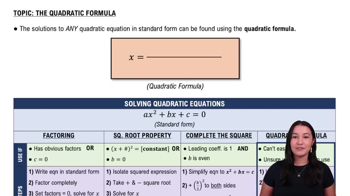
Quadratic Formula

Pythagorean Identity

The Pythagorean identity, sin²(θ) + cos²(θ) = 1, relates sine and cosine values of the same angle. After finding one function's value using the double-angle formula, this identity helps compute the other, ensuring the values satisfy the fundamental trigonometric relationship.
Video consigliato:
Percorso guidato
6:25
Pythagorean Identities