Ch. 5 - Trigonometric Identities
Lial - Trigonometry 12th Edition
Lial12th EditionTrigonometryISBN: 9780136552161, 9780135440780, 9780136881117, 9780135440827, 9780135924891Non è quello che usi tu?Cambia libro di testo
Capitolo 6, Problema 34

Simplify each expression.
√[(1 + cos 76°)/2]

Guida verificata passo dopo passo
1
Recognize that the expression inside the square root, \(\frac{1 + \cos 76^\circ}{2}\), matches the form of the half-angle identity for cosine: \(\cos^2 \left( \frac{\theta}{2} \right) = \frac{1 + \cos \theta}{2}\).
Identify the angle \(\theta\) in the expression as \(76^\circ\), so the half-angle is \(\frac{76^\circ}{2} = 38^\circ\).
Rewrite the expression inside the square root using the half-angle identity: \(\frac{1 + \cos 76^\circ}{2} = \cos^2 38^\circ\).
Since the original expression is \(\sqrt{\frac{1 + \cos 76^\circ}{2}}\), substitute the equivalent expression to get \(\sqrt{\cos^2 38^\circ}\).
Simplify the square root of the square to \(|\cos 38^\circ|\). Because \(38^\circ\) is in the first quadrant where cosine is positive, this simplifies to \(\cos 38^\circ\).

Risposta video verificata per un problema simile:

Questa soluzione video è stata consigliata dai nostri tutor come utile per risolvere questo problema.

Concetti chiave

Ecco i concetti essenziali che devi comprendere per rispondere correttamente alla domanda.

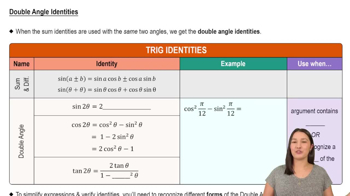
Half-Angle Identity for Cosine

The half-angle identity expresses the cosine of an angle in terms of the cosine of half that angle. Specifically, (1 + cos θ)/2 equals cos²(θ/2). This identity helps simplify expressions involving cosines of angles by relating them to squares of cosines of half-angles.
Video consigliato:
Percorso guidato
05:06
Double Angle Identities

Square Root and Absolute Value Relationship

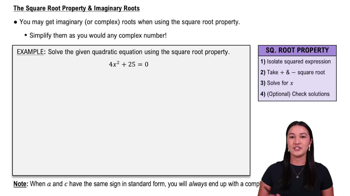
When simplifying square roots of squared trigonometric functions, the result is the absolute value of the original function. For example, √(cos² α) = |cos α|, ensuring the output is non-negative, which is important when simplifying expressions involving square roots.
Video consigliato:
Percorso guidato
2:20
Imaginary Roots with the Square Root Property

Evaluating Trigonometric Functions at Specific Angles

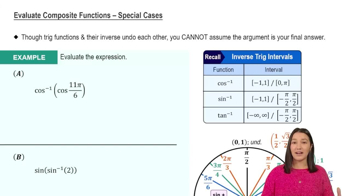
Understanding how to evaluate trigonometric functions at given angles, such as 38° (half of 76°), is essential. This involves either using a calculator or known values to find the cosine or sine of specific angles, enabling the simplification of expressions involving numerical angle measures.
Video consigliato:
Percorso guidato
3:48
Evaluate Composite Functions - Special Cases