Ch. 5 - Trigonometric Identities
Lial - Trigonometry 12th Edition
Lial12th EditionTrigonometryISBN: 9780136552161, 9780135440780, 9780136881117, 9780135440827, 9780135924891Non è quello che usi tu?Cambia libro di testo
Capitolo 6, Problema 5.6.18

The half-angle identity
tan A/2 = ± √[(1 - cosA)/(1 + cos A)]
can be used to find tan 22.5° = √(3 - 2√2), and the half-angle identity
tan A/2 = sin A/(1 + cos A)
can be used to find tan 22.5° = √2 - 1. Show that these answers are the same, without using a calculator. (Hint: If a > 0 and b > 0 and a² = b², then a = b.)

Guida verificata passo dopo passo
1
Start by writing down the two expressions for \( \tan 22.5^\circ \) given in the problem: \( \tan 22.5^\circ = \sqrt{3 - 2\sqrt{2}} \) and \( \tan 22.5^\circ = \sqrt{2} - 1 \). Our goal is to show these two expressions are equal without using a calculator.
Square both expressions to use the hint that if \( a > 0 \), \( b > 0 \), and \( a^2 = b^2 \), then \( a = b \). First, square \( \sqrt{3 - 2\sqrt{2}} \) to get \( 3 - 2\sqrt{2} \).
Next, square \( \sqrt{2} - 1 \). Use the formula for squaring a binomial: \( (x - y)^2 = x^2 - 2xy + y^2 \). So, \( (\sqrt{2} - 1)^2 = (\sqrt{2})^2 - 2 \times \sqrt{2} \times 1 + 1^2 = 2 - 2\sqrt{2} + 1 \).
Simplify the squared form of \( \sqrt{2} - 1 \) to get \( 3 - 2\sqrt{2} \), which matches the squared form of the first expression.
Since both squared expressions are equal and both original expressions are positive (as tangent of 22.5° is positive), conclude that \( \sqrt{3 - 2\sqrt{2}} = \sqrt{2} - 1 \), proving the two forms of \( \tan 22.5^\circ \) are the same.

Risposta video verificata per un problema simile:

Questa soluzione video è stata consigliata dai nostri tutor come utile per risolvere questo problema.

Concetti chiave

Ecco i concetti essenziali che devi comprendere per rispondere correttamente alla domanda.

Half-Angle Identities for Tangent

Half-angle identities express the tangent of half an angle in terms of sine and cosine of the original angle. Two common forms are tan(A/2) = ±√[(1 - cos A)/(1 + cos A)] and tan(A/2) = sin A / (1 + cos A). These identities help simplify trigonometric expressions and calculate exact values for angles like 22.5°.
Video consigliato:
Percorso guidato
05:06
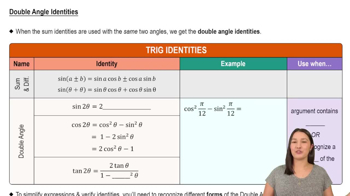
Double Angle Identities

Simplifying Radical Expressions

Simplifying radical expressions involves manipulating square roots and nested radicals to show equivalence or reduce complexity. This skill is essential to prove that two seemingly different expressions, such as √(3 - 2√2) and √2 - 1, represent the same value without using a calculator.
Video consigliato:
Percorso guidato
6:36
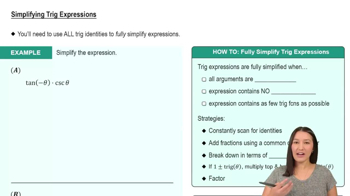
Simplifying Trig Expressions

Using the Property of Equality of Squares

The property states that if a > 0, b > 0, and a² = b², then a = b. This allows one to prove equality of two positive expressions by comparing their squares. It is useful in trigonometry to verify that two different forms of an expression for tan(A/2) are indeed equal.
Video consigliato:
Percorso guidato
2:20
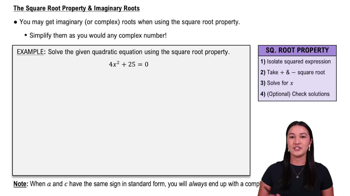
Imaginary Roots with the Square Root Property