Ch. 5 - Trigonometric Identities
Lial - Trigonometry 12th Edition
Lial12th EditionTrigonometryISBN: 9780136552161, 9780135440780, 9780136881117, 9780135440827, 9780135924891Non è quello che usi tu?Cambia libro di testo
Capitolo 6, Problema 56a

Use the given information to find sin(s + t). See Example 3.
cos s = -1/5 and sin t = 3/5, s and t in quadrant II

Guida verificata passo dopo passo
1
Identify the given information: \( \cos s = -\frac{1}{5} \), \( \sin t = \frac{3}{5} \), and both angles \( s \) and \( t \) are in quadrant II.
Recall that in quadrant II, sine is positive and cosine is negative. Use the Pythagorean identity to find \( \sin s \) and \( \cos t \). For \( s \), use \( \sin^2 s + \cos^2 s = 1 \) to find \( \sin s = \sqrt{1 - \cos^2 s} \), and since \( s \) is in quadrant II, \( \sin s > 0 \).
Similarly, for \( t \), use \( \sin^2 t + \cos^2 t = 1 \) to find \( \cos t = \sqrt{1 - \sin^2 t} \), and since \( t \) is in quadrant II, \( \cos t < 0 \).
Use the sine addition formula: \( \sin(s + t) = \sin s \cos t + \cos s \sin t \). Substitute the values of \( \sin s \), \( \cos t \), \( \cos s \), and \( \sin t \) into this formula.
Simplify the expression to write \( \sin(s + t) \) in terms of the known values and radicals, without calculating the final numeric value.

Risposta video verificata per un problema simile:

Questa soluzione video è stata consigliata dai nostri tutor come utile per risolvere questo problema.

Concetti chiave

Ecco i concetti essenziali che devi comprendere per rispondere correttamente alla domanda.

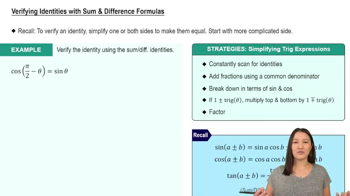
Trigonometric Angle Sum Identity

The sine of the sum of two angles, sin(s + t), can be found using the identity sin(s + t) = sin s cos t + cos s sin t. This formula allows us to express the sine of a combined angle in terms of the sines and cosines of the individual angles.
Video consigliato:
Percorso guidato
2:25
Verifying Identities with Sum and Difference Formulas

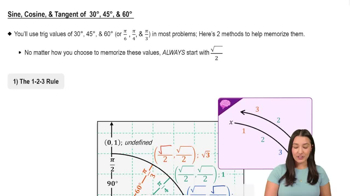
Determining Sine and Cosine Values in Quadrants

Knowing the quadrant of an angle helps determine the sign of its sine and cosine values. In quadrant II, sine is positive and cosine is negative. This information is crucial for correctly assigning signs to trigonometric values when solving problems.
Video consigliato:
Percorso guidato
5:08
Sine, Cosine, & Tangent of 30°, 45°, & 60°

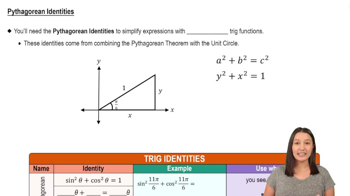
Using Pythagorean Identity to Find Missing Values

The Pythagorean identity, sin²θ + cos²θ = 1, allows calculation of a missing sine or cosine value when the other is known. For example, if cos s is given, sin s can be found by rearranging the identity and considering the quadrant to assign the correct sign.
Video consigliato:
Percorso guidato
6:25
Pythagorean Identities