Ch. 6 - Inverse Circular Functions and Trigonometric Equations
Lial - Trigonometry 12th Edition
Lial12th EditionTrigonometryISBN: 9780136552161, 9780135440780, 9780136881117, 9780135440827, 9780135924891Non è quello che usi tu?Cambia libro di testo
Capitolo 7, Problema 31

Evaluate each expression without using a calculator.
cos (csc⁻¹ (-2))

Guida verificata passo dopo passo
1
Recognize that the expression involves the inverse cosecant function: \(\csc^{-1}(-2)\). Let \(\theta = \csc^{-1}(-2)\), which means \(\csc \theta = -2\).
Recall the definition of cosecant: \(\csc \theta = \frac{1}{\sin \theta}\). From \(\csc \theta = -2\), we get \(\sin \theta = \frac{1}{-2} = -\frac{1}{2}\).
Determine the quadrant where \(\theta\) lies. Since \(\csc^{-1} x\) typically returns values in \([-\frac{\pi}{2}, 0) \cup (0, \frac{\pi}{2}]\) excluding zero, and \(\sin \theta = -\frac{1}{2}\) is negative, \(\theta\) must be in the fourth quadrant.
Use the Pythagorean identity to find \(\cos \theta\): \(\cos \theta = \pm \sqrt{1 - \sin^2 \theta} = \pm \sqrt{1 - \left(-\frac{1}{2}\right)^2} = \pm \sqrt{1 - \frac{1}{4}} = \pm \sqrt{\frac{3}{4}} = \pm \frac{\sqrt{3}}{2}\).
Determine the sign of \(\cos \theta\) in the fourth quadrant. Since cosine is positive in the fourth quadrant, \(\cos \theta = \frac{\sqrt{3}}{2}\). Therefore, \(\cos(\csc^{-1}(-2)) = \frac{\sqrt{3}}{2}\).

Risposta video verificata per un problema simile:

Questa soluzione video è stata consigliata dai nostri tutor come utile per risolvere questo problema.

Concetti chiave

Ecco i concetti essenziali che devi comprendere per rispondere correttamente alla domanda.

Inverse Cosecant Function (csc⁻¹)

The inverse cosecant function, csc⁻¹(x), returns an angle whose cosecant is x. Since cosecant is the reciprocal of sine, csc⁻¹(x) gives an angle θ such that sin(θ) = 1/x. Understanding the domain and range of csc⁻¹ is essential for correctly interpreting the angle.
Video consigliato:
Percorso guidato
6:22
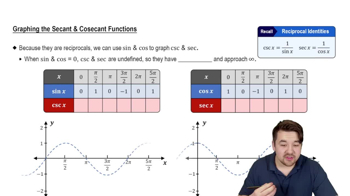
Graphs of Secant and Cosecant Functions

Relationship Between Sine and Cosine

Sine and cosine are fundamental trigonometric functions related by the Pythagorean identity: sin²(θ) + cos²(θ) = 1. Knowing one value allows you to find the other, considering the quadrant of the angle to determine the sign of cosine.
Video consigliato:
Percorso guidato
5:05
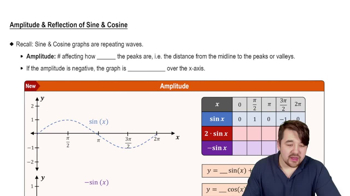
Amplitude and Reflection of Sine and Cosine

Evaluating Trigonometric Expressions Without a Calculator

To evaluate expressions like cos(csc⁻¹(-2)) without a calculator, use known values and identities. Start by finding the angle from the inverse function, then apply trigonometric identities and sign rules based on the angle's quadrant to find the exact value.
Video consigliato:
Percorso guidato
3:48
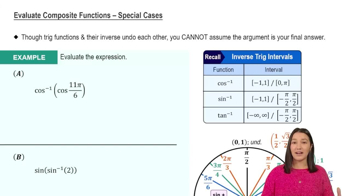
Evaluate Composite Functions - Special Cases