Ch. 6 - Inverse Circular Functions and Trigonometric Equations
Lial - Trigonometry 12th Edition
Lial12th EditionTrigonometryISBN: 9780136552161, 9780135440780, 9780136881117, 9780135440827, 9780135924891Non è quello che usi tu?Cambia libro di testo
Capitolo 7, Problema 25

Find the exact value of each real number y if it exists. Do not use a calculator.
y = sin⁻¹ √3

Guida verificata passo dopo passo
1
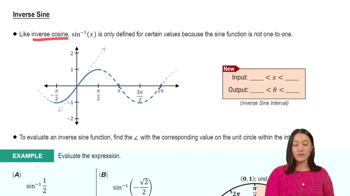
Recall the domain of the inverse sine function \(\sin^{-1}(x)\), which is \([-1, 1]\). This means the input to \(\sin^{-1}\) must be between \(-1\) and \(1\) inclusive.
Check the value inside the inverse sine function: \(\sqrt{3}\). Since \(\sqrt{3} \approx 1.732\), it is greater than \(1\).
Since \(\sqrt{3}\) is outside the domain of \(\sin^{-1}\), there is no real number \(y\) such that \(y = \sin^{-1}(\sqrt{3})\).
Therefore, the problem has no solution in the set of real numbers because the input to \(\sin^{-1}\) is invalid.
If you want to explore complex solutions, that would involve extending the inverse sine function to complex numbers, but for real numbers, no solution exists.

Risposta video verificata per un problema simile:

Questa soluzione video è stata consigliata dai nostri tutor come utile per risolvere questo problema.

Concetti chiave

Ecco i concetti essenziali che devi comprendere per rispondere correttamente alla domanda.

Inverse Sine Function (sin⁻¹ or arcsin)

The inverse sine function, sin⁻¹(x), returns the angle whose sine is x. Its output range is limited to [-π/2, π/2] to ensure it is a function. Understanding this helps find the angle y such that sin(y) equals the given value.
Video consigliato:

Domain of the Sine Function and Its Inverse

The sine function outputs values only between -1 and 1, so the input to sin⁻¹ must lie within this range. Since √3 is approximately 1.732, which is outside this domain, no real y satisfies sin(y) = √3, indicating no real solution exists.
Video consigliato:

Exact Values of Sine for Special Angles

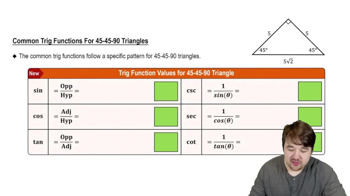
Common exact sine values include sin(π/6) = 1/2, sin(π/4) = √2/2, and sin(π/3) = √3/2. Recognizing these helps identify if the given value corresponds to a known angle. Since √3 is not among these values, it further confirms no exact real angle exists for sin⁻¹(√3).
Video consigliato:
Percorso guidato
3:28
Common Trig Functions For 45-45-90 Triangles