Ch. 6 - Inverse Circular Functions and Trigonometric Equations
Lial - Trigonometry 12th Edition
Lial12th EditionTrigonometryISBN: 9780136552161, 9780135440780, 9780136881117, 9780135440827, 9780135924891Non è quello che usi tu?Cambia libro di testo
Capitolo 7, Problema 23

Solve each equation for exact solutions over the interval [0, 2π).
cos² x + 2 cos x + 1 = 0

Guida verificata passo dopo passo
1
Recognize that the equation is a quadratic in terms of \( \cos x \). Rewrite the equation as \( (\cos x)^2 + 2 \cos x + 1 = 0 \).
Notice that the quadratic expression can be factored as \( (\cos x + 1)^2 = 0 \).
Set the factor equal to zero: \( \cos x + 1 = 0 \), which simplifies to \( \cos x = -1 \).
Recall the unit circle values where \( \cos x = -1 \) within the interval \( [0, 2\pi) \).
Identify the exact solution(s) for \( x \) where \( \cos x = -1 \) in the given interval.

Risposta video verificata per un problema simile:

Questa soluzione video è stata consigliata dai nostri tutor come utile per risolvere questo problema.

Concetti chiave

Ecco i concetti essenziali che devi comprendere per rispondere correttamente alla domanda.

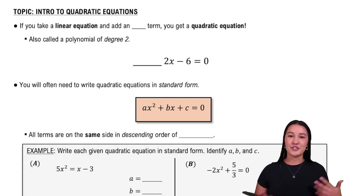
Quadratic Form in Trigonometric Equations

Many trigonometric equations can be rewritten as quadratic equations by substituting a trigonometric function (e.g., cos x) with a variable. This allows the use of algebraic methods like factoring or the quadratic formula to find solutions.
Video consigliato:
Percorso guidato
5:35
Introduction to Quadratic Equations

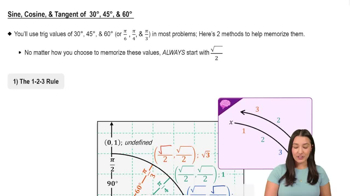
Solving for Cosine Values

After rewriting the equation in quadratic form, solving for cos x involves finding the roots of the quadratic. These roots represent the cosine values for which the original equation holds true, which can then be used to find the corresponding angles.
Video consigliato:
Percorso guidato
5:08
Sine, Cosine, & Tangent of 30°, 45°, & 60°

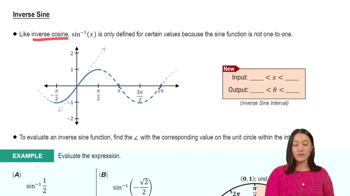
Finding Exact Solutions on the Interval [0, 2π)

Once the cosine values are found, the exact solutions for x are determined by identifying all angles within the interval [0, 2π) whose cosine matches those values. This often involves using the unit circle and understanding cosine symmetry.
Video consigliato: