Ch. 6 - Inverse Circular Functions and Trigonometric Equations
Lial - Trigonometry 12th Edition
Lial12th EditionTrigonometryISBN: 9780136552161, 9780135440780, 9780136881117, 9780135440827, 9780135924891Non è quello che usi tu?Cambia libro di testo
Capitolo 7, Problema 47

Solve each equation for exact solutions.
cos⁻¹ x + tan⁻¹ x = π/2

Guida verificata passo dopo passo
1
Recognize that the equation is given as \(\cos^{-1} x + \tan^{-1} x = \frac{\pi}{2}\). Our goal is to find all values of \(x\) that satisfy this equation exactly.
Recall the identity involving inverse trigonometric functions: if \(\cos^{-1} x + \sin^{-1} x = \frac{\pi}{2}\), then we can try to relate \(\tan^{-1} x\) to \(\sin^{-1} x\) or \(\cos^{-1} x\) to simplify the expression.
Use the substitution \(\theta = \cos^{-1} x\), which implies \(x = \cos \theta\) and \(\theta \in [0, \pi]\). Then rewrite the equation as \(\theta + \tan^{-1}(\cos \theta) = \frac{\pi}{2}\).
Isolate \(\tan^{-1}(\cos \theta)\) to get \(\tan^{-1}(\cos \theta) = \frac{\pi}{2} - \theta\). Then take the tangent of both sides to obtain \(\cos \theta = \tan\left(\frac{\pi}{2} - \theta\right)\).
Use the co-function identity \(\tan\left(\frac{\pi}{2} - \theta\right) = \cot \theta = \frac{\cos \theta}{\sin \theta}\). Substitute this back to get \(\cos \theta = \frac{\cos \theta}{\sin \theta}\). From here, solve for \(\theta\) and then find \(x = \cos \theta\).

Risposta video verificata per un problema simile:

Questa soluzione video è stata consigliata dai nostri tutor come utile per risolvere questo problema.

Concetti chiave

Ecco i concetti essenziali che devi comprendere per rispondere correttamente alla domanda.

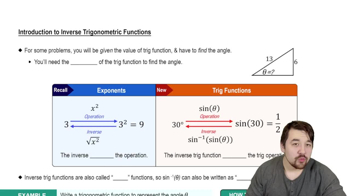
Inverse Trigonometric Functions

Inverse trigonometric functions, such as cos⁻¹(x) and tan⁻¹(x), return the angle whose trigonometric ratio equals x. They are used to find angles from known ratios and have specific ranges to ensure they are functions. Understanding their definitions and ranges is essential for solving equations involving them.
Video consigliato:
Percorso guidato
4:28
Introduction to Inverse Trig Functions

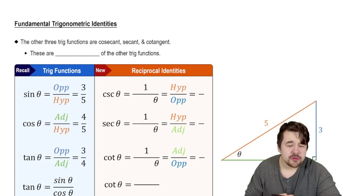
Trigonometric Identities Involving Inverse Functions

Certain identities relate inverse trigonometric functions, such as cos⁻¹(x) + sin⁻¹(x) = π/2. Recognizing or deriving similar identities helps simplify and solve equations involving sums of inverse trig functions. These identities often rely on complementary angle relationships.
Video consigliato:
Percorso guidato
5:32
Fundamental Trigonometric Identities

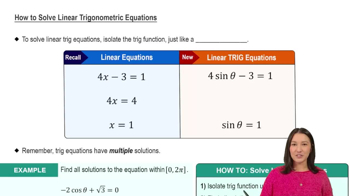
Solving Equations with Inverse Trigonometric Expressions

Solving equations like cos⁻¹(x) + tan⁻¹(x) = π/2 requires manipulating inverse trig expressions, possibly by expressing one function in terms of another or using substitution. Understanding domain restrictions and exact values of inverse functions aids in finding precise solutions.
Video consigliato:
Percorso guidato
4:34
How to Solve Linear Trigonometric Equations