Ch. 6 - Inverse Circular Functions and Trigonometric Equations
Lial - Trigonometry 12th Edition
Lial12th EditionTrigonometryISBN: 9780136552161, 9780135440780, 9780136881117, 9780135440827, 9780135924891Non è quello che usi tu?Cambia libro di testo
Capitolo 7, Problema 6.RE.49

Solve each equation over the interval [0°, 360°). Write solutions as exact values or to the nearest tenth of a degree, as appropriate.
3 cos² θ + 2 cos θ - 1 = 0

Guida verificata passo dopo passo
1
Recognize that the given equation is a quadratic in terms of \( \cos \theta \): \( 3 \cos^{2} \theta + 2 \cos \theta - 1 = 0 \). To solve it, let \( x = \cos \theta \), so the equation becomes \( 3x^{2} + 2x - 1 = 0 \).
Use the quadratic formula to solve for \( x \): \( x = \frac{-b \pm \sqrt{b^{2} - 4ac}}{2a} \), where \( a = 3 \), \( b = 2 \), and \( c = -1 \).
Calculate the discriminant \( \Delta = b^{2} - 4ac \) and then find the two possible values for \( x = \cos \theta \).
For each value of \( x \), determine the corresponding angles \( \theta \) in the interval \( [0^{\circ}, 360^{\circ}) \) by using the inverse cosine function: \( \theta = \cos^{-1}(x) \). Remember that cosine is positive in Quadrants I and IV, and negative in Quadrants II and III, so find all angles that satisfy each \( x \).
Write the solutions as exact values if possible, or round to the nearest tenth of a degree as appropriate, ensuring all solutions lie within the given interval.

Risposta video verificata per un problema simile:

Questa soluzione video è stata consigliata dai nostri tutor come utile per risolvere questo problema.

Concetti chiave

Ecco i concetti essenziali che devi comprendere per rispondere correttamente alla domanda.

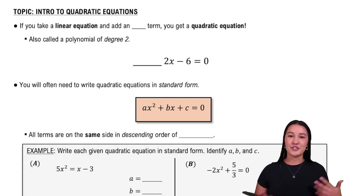
Quadratic Equations in Trigonometric Functions

This concept involves treating trigonometric equations like algebraic quadratics by substituting the trigonometric function (e.g., cos θ) as a variable. Solving the quadratic yields possible values for the function, which can then be used to find the angle θ.
Video consigliato:
Percorso guidato
5:35
Introduction to Quadratic Equations

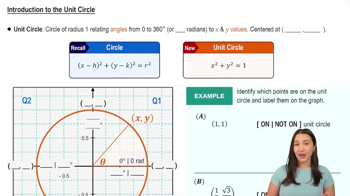
Unit Circle and Angle Measurement

Understanding the unit circle helps relate cosine values to specific angles within the interval [0°, 360°). Each cosine value corresponds to one or two angles in this range, depending on the sign and magnitude, which is essential for finding all solutions.
Video consigliato:
Percorso guidato
06:11
Introduction to the Unit Circle

Exact Values and Approximation in Trigonometry

Some trigonometric solutions correspond to well-known exact values (like cos 60° = 0.5), while others require approximation using a calculator. Recognizing when to use exact values or round to the nearest tenth degree ensures precise and appropriate answers.
Video consigliato:
Percorso guidato
5:32
Fundamental Trigonometric Identities