Ch. 6 - Inverse Circular Functions and Trigonometric Equations
Lial - Trigonometry 12th Edition
Lial12th EditionTrigonometryISBN: 9780136552161, 9780135440780, 9780136881117, 9780135440827, 9780135924891Non è quello che usi tu?Cambia libro di testo
Capitolo 7, Problema 6.2.45

Solve each equation over the interval [0°, 360°). Write solutions as exact values or to the nearest tenth, as appropriate.
cot θ + 2 csc θ = 3

Guida verificata passo dopo passo
1
Start by expressing the given equation \(\cot \theta + 2 \csc \theta = 3\) in terms of sine and cosine functions. Recall that \(\cot \theta = \frac{\cos \theta}{\sin \theta}\) and \(\csc \theta = \frac{1}{\sin \theta}\).
Rewrite the equation using these definitions: \(\frac{\cos \theta}{\sin \theta} + 2 \cdot \frac{1}{\sin \theta} = 3\).
Combine the terms over a common denominator \(\sin \theta\): \(\frac{\cos \theta + 2}{\sin \theta} = 3\).
Multiply both sides of the equation by \(\sin \theta\) to eliminate the denominator, giving \(\cos \theta + 2 = 3 \sin \theta\).
Rearrange the equation to isolate terms and prepare for solving: \(\cos \theta - 3 \sin \theta = -2\). From here, consider using trigonometric identities or methods such as expressing the left side as a single sine or cosine function to find \(\theta\) within the interval \([0^\circ, 360^\circ)\).

Concetti chiave

Ecco i concetti essenziali che devi comprendere per rispondere correttamente alla domanda.

Trigonometric Identities

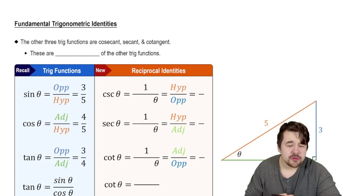
Trigonometric identities are equations involving trigonometric functions that hold true for all values within their domains. In this problem, identities relating cotangent and cosecant, such as cot θ = cos θ / sin θ and csc θ = 1 / sin θ, are essential to rewrite and simplify the equation for easier solving.
Video consigliato:
Percorso guidato
5:32
Fundamental Trigonometric Identities

Solving Trigonometric Equations

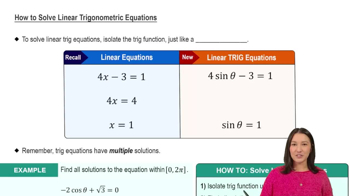
Solving trigonometric equations involves isolating the trigonometric function and finding all angle solutions within a specified interval. This often requires algebraic manipulation, substitution, and using inverse trigonometric functions to determine exact or approximate angle values.
Video consigliato:
Percorso guidato
4:34
How to Solve Linear Trigonometric Equations

Interval and Angle Measurement

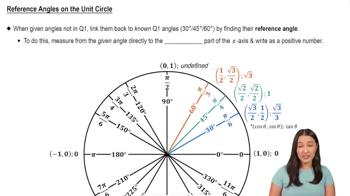
The problem restricts solutions to the interval [0°, 360°), meaning all solutions must be found within one full rotation of the unit circle. Understanding how angles correspond to points on the unit circle and how to interpret solutions within this range is crucial for providing correct and complete answers.
Video consigliato:
Percorso guidato
5:31
Reference Angles on the Unit Circle