Ch. 6 - Inverse Circular Functions and Trigonometric Equations
Lial - Trigonometry 12th Edition
Lial12th EditionTrigonometryISBN: 9780136552161, 9780135440780, 9780136881117, 9780135440827, 9780135924891Non è quello che usi tu?Cambia libro di testo
Capitolo 7, Problema 1

Use the unit circle shown here to solve each simple trigonometric equation. If the variable is x, then solve over [0, 2π). If the variable is θ, then solve over [0°, 360°).
<IMAGE>
cos x = 1/2

Guida verificata passo dopo passo
1
Recall that on the unit circle, the cosine of an angle corresponds to the x-coordinate of the point where the terminal side of the angle intersects the circle.
Identify the angles in the interval \([0, 2\pi)\) where the cosine value is \(\frac{1}{2}\). These are the angles where the x-coordinate equals \(\frac{1}{2}\).
From the unit circle, note that \(\cos x = \frac{1}{2}\) at two standard positions: one in the first quadrant and one in the fourth quadrant.
Write down the general solutions for \(x\) in radians: \(x = \frac{\pi}{3}\) (first quadrant) and \(x = 2\pi - \frac{\pi}{3}\) (fourth quadrant).
Verify that both solutions lie within the interval \([0, 2\pi)\) and list them as the final answers.

Risposta video verificata per un problema simile:

Questa soluzione video è stata consigliata dai nostri tutor come utile per risolvere questo problema.

Concetti chiave

Ecco i concetti essenziali che devi comprendere per rispondere correttamente alla domanda.

Unit Circle and Angle Measurement

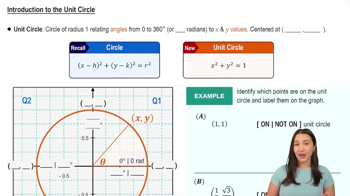
The unit circle is a circle with radius 1 centered at the origin of the coordinate plane. It helps relate angles to coordinates, where the x-coordinate corresponds to cosine and the y-coordinate to sine of the angle. Angles can be measured in radians (0 to 2π) or degrees (0° to 360°), and understanding this is essential for solving trigonometric equations within specified intervals.
Video consigliato:
Percorso guidato
06:11
Introduction to the Unit Circle

Cosine Function and Its Values

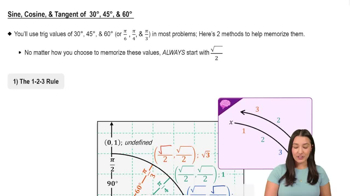
The cosine of an angle in the unit circle is the x-coordinate of the corresponding point. Knowing the cosine values for common angles (like π/3 or 60° where cos = 1/2) allows you to identify solutions to equations such as cos x = 1/2. Since cosine is positive in the first and fourth quadrants, multiple solutions may exist within the given interval.
Video consigliato:
Percorso guidato
5:08
Sine, Cosine, & Tangent of 30°, 45°, & 60°

Solving Trigonometric Equations Over an Interval

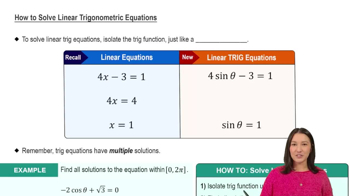
Solving equations like cos x = 1/2 over a specific interval requires finding all angles within that range that satisfy the equation. This involves identifying reference angles and considering the symmetry of the unit circle, as cosine values repeat in different quadrants. Solutions must be expressed within the given domain, either [0, 2π) for radians or [0°, 360°) for degrees.
Video consigliato:
Percorso guidato
4:34
How to Solve Linear Trigonometric Equations