Ch. 6 - Inverse Circular Functions and Trigonometric Equations
Lial - Trigonometry 12th Edition
Lial12th EditionTrigonometryISBN: 9780136552161, 9780135440780, 9780136881117, 9780135440827, 9780135924891Non è quello che usi tu?Cambia libro di testo
Capitolo 7, Problema 97

Write each trigonometric expression as an algebraic expression in u, for u > 0.
cos (arcsin u)

Guida verificata passo dopo passo
1
Recognize that the expression is \( \cos(\arcsin u) \). Here, \( \arcsin u \) represents an angle \( \theta \) such that \( \sin \theta = u \).
Set \( \theta = \arcsin u \), so by definition, \( \sin \theta = u \). Since \( u > 0 \), \( \theta \) is in the range \( \left[-\frac{\pi}{2}, \frac{\pi}{2}\right] \) where cosine is non-negative.
Use the Pythagorean identity for sine and cosine: \( \sin^2 \theta + \cos^2 \theta = 1 \). Substitute \( \sin \theta = u \) to get \( u^2 + \cos^2 \theta = 1 \).
Solve for \( \cos \theta \): \( \cos \theta = \sqrt{1 - u^2} \). Since \( \theta \) is in the first or fourth quadrant (due to the range of arcsin), cosine is positive, so take the positive root.
Therefore, \( \cos(\arcsin u) = \sqrt{1 - u^2} \), which is the algebraic expression in terms of \( u \).

Risposta video verificata per un problema simile:

Questa soluzione video è stata consigliata dai nostri tutor come utile per risolvere questo problema.

Concetti chiave

Ecco i concetti essenziali che devi comprendere per rispondere correttamente alla domanda.

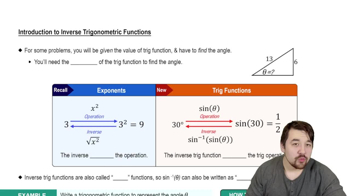
Inverse Trigonometric Functions

Inverse trigonometric functions, like arcsin, return the angle whose trigonometric ratio equals a given value. For example, arcsin(u) gives an angle θ such that sin(θ) = u. Understanding this allows us to rewrite expressions involving inverse functions in terms of angles.
Video consigliato:
Percorso guidato
4:28
Introduction to Inverse Trig Functions

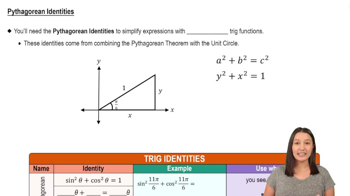
Pythagorean Identity

The Pythagorean identity states that for any angle θ, sin²(θ) + cos²(θ) = 1. This relationship helps express one trigonometric function in terms of another, such as finding cos(θ) when sin(θ) is known, which is essential for rewriting cos(arcsin u) algebraically.
Video consigliato:
Percorso guidato
6:25
Pythagorean Identities

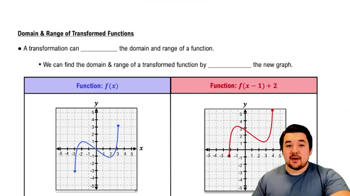
Domain and Range Considerations

When dealing with inverse trigonometric functions, it's important to consider the domain and range to determine the correct sign of the resulting expression. Since u > 0 and arcsin(u) lies in [-π/2, π/2], cos(arcsin u) will be non-negative, guiding the choice of the positive root in the algebraic expression.
Video consigliato:
Percorso guidato
4:22
Domain and Range of Function Transformations