Ch. 7 - Applications of Trigonometry and Vectors
Lial - Trigonometry 12th Edition
Lial12th EditionTrigonometryISBN: 9780136552161, 9780135440780, 9780136881117, 9780135440827, 9780135924891Non è quello che usi tu?Cambia libro di testo
Capitolo 8, Problema 35

A force of 176 lb makes an angle of 78° 50′ with a second force. The resultant of the two forces makes an angle of 41° 10′ with the first force. Find the magnitudes of the second force and of the resultant.


<IMAGE>

Guida verificata passo dopo passo
1
Convert all given angles from degrees and minutes to decimal degrees for easier calculation. For example, 78° 50′ becomes 78 + 50/60 degrees, and similarly for 41° 10′.
Label the forces: let the first force be \( F_1 = 176 \) lb, the second force be \( F_2 \), and the resultant force be \( R \). The angle between \( F_1 \) and \( F_2 \) is \( \theta = 78.8333^\circ \) (converted from 78° 50′), and the angle between \( F_1 \) and \( R \) is \( \alpha = 41.1667^\circ \) (converted from 41° 10′).
Use the Law of Cosines to express the magnitude of the resultant force \( R \) in terms of \( F_1 \), \( F_2 \), and \( \theta \): \[ R^2 = F_1^2 + F_2^2 + 2 F_1 F_2 \cos(\theta) \]
Use the Law of Sines or the formula for the angle between two vectors to relate the given angle \( \alpha \) to the forces. Specifically, use the formula for the tangent of the angle between \( F_1 \) and \( R \): \[ \tan(\alpha) = \frac{F_2 \sin(\theta)}{F_1 + F_2 \cos(\theta)} \] This equation allows you to solve for \( F_2 \).
Solve the equation from step 4 for \( F_2 \), then substitute \( F_2 \) back into the Law of Cosines equation from step 3 to find the magnitude of the resultant force \( R \).

Risposta video verificata per un problema simile:

Questa soluzione video è stata consigliata dai nostri tutor come utile per risolvere questo problema.

Concetti chiave

Ecco i concetti essenziali che devi comprendere per rispondere correttamente alla domanda.

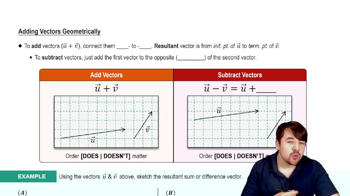
Vector Addition of Forces

When two forces act at an angle, their combined effect is found by vector addition. The resultant force is the vector sum of the individual forces, and its magnitude and direction depend on both the magnitudes and the angle between the forces.
Video consigliato:
Percorso guidato
05:29
Adding Vectors Geometrically

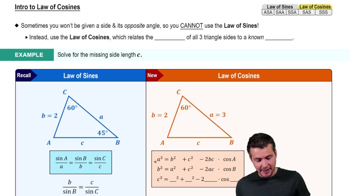
Law of Cosines

The Law of Cosines relates the lengths of sides of a triangle to the cosine of one of its angles. It is used to find the magnitude of the resultant force when two forces and the angle between them are known, or to find an unknown force when the resultant and angles are given.
Video consigliato:
Percorso guidato
4:35
Intro to Law of Cosines

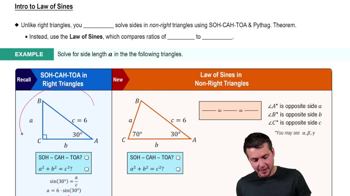
Law of Sines

The Law of Sines relates the ratios of the lengths of sides of a triangle to the sines of their opposite angles. It helps determine unknown angles or side lengths in the force triangle, especially when the resultant's angle relative to one force is given.
Video consigliato:
Percorso guidato
4:27
Intro to Law of Sines