
Ch. 7 - Applications of Trigonometry and Vectors
Lial - Trigonometry 12th Edition
Lial12th EditionTrigonometryISBN: 9780136552161, 9780135440780, 9780136881117, 9780135440827, 9780135924891Non è quello che usi tu?Cambia libro di testo
Capitolo 8, Problema 49

A plane has an airspeed of 520 mph. The pilot wishes to fly on a bearing of 310°. A wind of 37 mph is blowing from a bearing of 212°. In what direction should the pilot fly, and what will be her ground speed?

Guida verificata passo dopo passo
1
Identify the vectors involved: the plane's airspeed vector (magnitude 520 mph, direction to be found), the wind vector (magnitude 37 mph, coming from bearing 212°), and the resultant ground speed vector (desired bearing 310°).
Convert the wind's bearing to a direction the wind is blowing towards by adding 180° to the wind's bearing (since wind direction is given as where it comes from). Calculate the wind vector components using \( V_{wind_x} = 37 \times \cos\left(\frac{(212 + 180) \times \pi}{180}\right) \) and \( V_{wind_y} = 37 \times \sin\left(\frac{(212 + 180) \times \pi}{180}\right) \).
Express the desired ground speed vector components using the bearing 310°: \( V_{ground_x} = V_{ground} \times \cos\left(\frac{310 \times \pi}{180}\right) \) and \( V_{ground_y} = V_{ground} \times \sin\left(\frac{310 \times \pi}{180}\right) \), where \( V_{ground} \) is the unknown ground speed magnitude.
Set up the vector equation for the plane's airspeed vector \( \vec{V}_{plane} \) such that \( \vec{V}_{plane} + \vec{V}_{wind} = \vec{V}_{ground} \). Using components, this becomes two equations: \( V_{plane_x} + V_{wind_x} = V_{ground_x} \) and \( V_{plane_y} + V_{wind_y} = V_{ground_y} \).
Use the known magnitude of the plane's airspeed (520 mph) and the two component equations to solve for the plane's heading angle (direction to fly) and the ground speed magnitude \( V_{ground} \). This involves expressing \( V_{plane_x} = 520 \times \cos\theta \) and \( V_{plane_y} = 520 \times \sin\theta \), then solving the system for \( \theta \) and \( V_{ground} \).

Risposta video verificata per un problema simile:

Questa soluzione video è stata consigliata dai nostri tutor come utile per risolvere questo problema.

Concetti chiave

Ecco i concetti essenziali che devi comprendere per rispondere correttamente alla domanda.

Vector Addition of Velocities

The plane's actual path over the ground is the vector sum of its airspeed and the wind velocity. To find the ground speed and direction, you add the velocity vector of the plane relative to the air to the wind's velocity vector, considering both magnitude and direction.
Video consigliato:
Percorso guidato
03:48
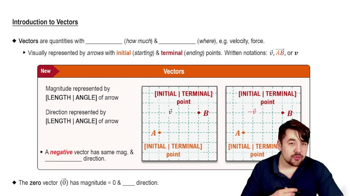
Introduction to Vectors

Bearing and Angle Conversion

Bearings are measured clockwise from the north (0° to 360°). Converting bearings into standard angles for trigonometric calculations involves translating these compass directions into angles relative to the positive x-axis, often using sine and cosine functions to resolve vectors into components.
Video consigliato:
Percorso guidato
04:46
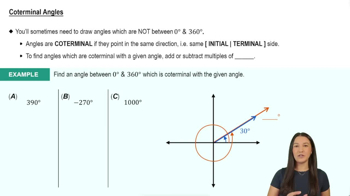
Coterminal Angles

Trigonometric Resolution of Vectors

To analyze the problem, velocities are broken into horizontal (x) and vertical (y) components using sine and cosine of the given angles. This allows for precise calculation of resultant velocity magnitude and direction by recombining these components using the Pythagorean theorem and inverse trigonometric functions.
Video consigliato:
Percorso guidato
03:48
Introduction to Vectors
Pratica correlata
Domanda del libro di testo

Solve each problem. See Examples 5 and 6.


Bearing and Ground Speed of a Plane An airline route from San Francisco to Honolulu is on a bearing of 233.0°. A jet flying at 450 mph on that bearing encounters a wind blowing at 39.0 mph from a direction of 114.0°. Find the resulting bearing and ground speed of the plane.

1146
views
Domanda del libro di testo

Find the area of each triangle using the formula 𝓐 = ½ bh, and then verify that the formula 𝓐 = ½ ab sin C gives the same result.

<IMAGE>

1174
views
Domanda del libro di testo

Find the area of each triangle ABC.

A = 42.5°, b = 13.6 m, c = 10.1 m

795
views
Domanda del libro di testo

Starting at point X, a ship sails 15.5 km on a bearing of 200°, then turns and sails 2.4 km on a bearing of 320°. Find the distance of the ship from point X.

853
views
Domanda del libro di testo

One boat pulls a barge with a force of 100 newtons. Another boat pulls the barge at an angle of 45° to the first force, with a force of 200 newtons. Find the resultant force acting on the barge, to the nearest unit, and the angle between the resultant and the first boat, to the nearest tenth.

745
views
Domanda del libro di testo

Solve each problem. See Examples 5 and 6.


Distance and Direction of a Motorboat A motorboat sets out in the direction N 80° 00′ E. The speed of the boat in still water is 20.0 mph. If the current is flowing directly south, and the actual direction of the motorboat is due east, find the speed of the current and the actual speed of the motorboat.


<IMAGE>

849
views