Ch. 7 - Applications of Trigonometry and Vectors
Lial - Trigonometry 12th Edition
Lial12th EditionTrigonometryISBN: 9780136552161, 9780135440780, 9780136881117, 9780135440827, 9780135924891Non è quello che usi tu?Cambia libro di testo
Capitolo 8, Problema 58

A plane is headed due south with an airspeed of 192 mph. A wind from a direction of 78.0° is blowing at 23.0 mph. Find the ground speed and resulting bearing of the plane.

Guida verificata passo dopo passo
1
Identify the vectors involved: The plane's velocity vector is due south with a magnitude of 192 mph, and the wind's velocity vector has a magnitude of 23 mph coming from 78.0°. Note that "from 78.0°" means the wind is blowing towards 78.0° + 180° = 258.0° (since wind direction is given as the direction it comes from).
Express both velocity vectors in component form using the standard coordinate system where 0° is east and angles increase counterclockwise. For the plane headed due south, its velocity vector components are \(V_p = (0, -192)\) mph. For the wind, convert the direction 258.0° to components: \(V_w = (23 \cos(258^\circ), 23 \sin(258^\circ))\) mph.
Add the two vectors component-wise to find the resultant ground velocity vector: \(V_g = V_p + V_w = (0 + 23 \cos(258^\circ), -192 + 23 \sin(258^\circ))\).
Calculate the magnitude of the ground velocity vector (ground speed) using the Pythagorean theorem: \(|V_g| = \sqrt{(V_{gx})^2 + (V_{gy})^2}\), where \(V_{gx}\) and \(V_{gy}\) are the x and y components of \(V_g\).
Determine the bearing (direction) of the ground velocity vector by finding the angle \(\theta\) it makes with the north direction. Use the inverse tangent function: \(\theta = \arctan\left(\frac{|V_{gx}|}{|V_{gy}|}\right)\), then adjust the angle based on the quadrant to express the bearing as an angle clockwise from north.

Risposta video verificata per un problema simile:

Questa soluzione video è stata consigliata dai nostri tutor come utile per risolvere questo problema.

Concetti chiave

Ecco i concetti essenziali che devi comprendere per rispondere correttamente alla domanda.

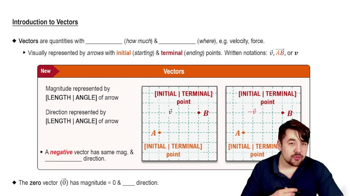
Vector Addition of Velocities

The plane's ground velocity is the vector sum of its airspeed and the wind velocity. This involves adding two vectors with magnitude and direction, typically by breaking them into components along the x (east-west) and y (north-south) axes, then combining these components to find the resultant vector.
Video consigliato:
Percorso guidato
03:48
Introduction to Vectors

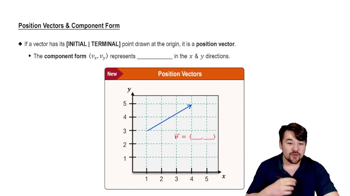
Resolving Vectors into Components

To add vectors, each vector is decomposed into horizontal (x) and vertical (y) components using trigonometric functions sine and cosine based on their given directions. This step simplifies the addition process and helps in calculating the resultant vector's magnitude and direction.
Video consigliato:
Percorso guidato
03:55
Position Vectors & Component Form

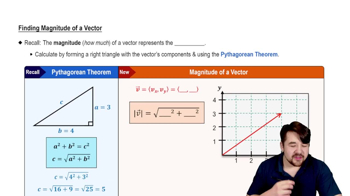
Calculating Resultant Magnitude and Bearing

After summing the components, the magnitude of the resultant vector (ground speed) is found using the Pythagorean theorem. The bearing (direction) is determined by calculating the angle of the resultant vector relative to a reference direction, often using the inverse tangent function and adjusting for compass bearings.
Video consigliato:
Percorso guidato
04:44
Finding Magnitude of a Vector