Ch. 7 - Applications of Trigonometry and Vectors
Lial - Trigonometry 12th Edition
Lial12th EditionTrigonometryISBN: 9780136552161, 9780135440780, 9780136881117, 9780135440827, 9780135924891Non è quello che usi tu?Cambia libro di testo
Capitolo 8, Problema 27b

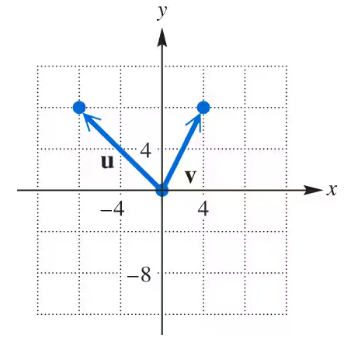
Use the figure to find each vector: u - v. Use vector notation as in Example 4.


Graph showing vectors u and v originating from the origin, with u pointing to (-4,4) and v pointing to (4,4) on an xy-coordinate plane.

Guida verificata passo dopo passo
1
Identify the components of vectors \( \mathbf{u} \) and \( \mathbf{v} \) from the figure. Typically, each vector can be expressed in component form as \( \mathbf{u} = \langle u_x, u_y \rangle \) and \( \mathbf{v} = \langle v_x, v_y \rangle \), where \( u_x \) and \( u_y \) are the horizontal and vertical components of \( \mathbf{u} \), and similarly for \( \mathbf{v} \).
Write down the components of \( \mathbf{u} \) and \( \mathbf{v} \) explicitly based on the figure, noting their directions and magnitudes along the x- and y-axes.
Subtract the components of \( \mathbf{v} \) from the components of \( \mathbf{u} \) to find \( \mathbf{u} - \mathbf{v} \). This is done component-wise: \( \mathbf{u} - \mathbf{v} = \langle u_x - v_x, u_y - v_y \rangle \).
Express the resulting vector \( \mathbf{u} - \mathbf{v} \) in vector notation, using angle brackets and the components you calculated.
If needed, verify your result by sketching the vectors \( \mathbf{u} \), \( \mathbf{v} \), and \( \mathbf{u} - \mathbf{v} \) to ensure the subtraction aligns with the geometric interpretation of vector subtraction.

Risposta video verificata per un problema simile:

Questa soluzione video è stata consigliata dai nostri tutor come utile per risolvere questo problema.

Concetti chiave

Ecco i concetti essenziali che devi comprendere per rispondere correttamente alla domanda.

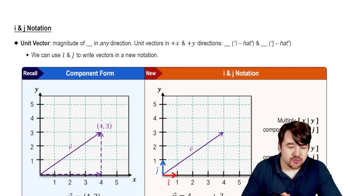
Vector Representation and Notation

Vectors are quantities with both magnitude and direction, often represented as directed line segments or coordinate pairs. Vector notation typically uses angle brackets, e.g., u = <x, y>, to denote components along the x and y axes. Understanding this notation is essential for performing vector operations like addition and subtraction.
Video consigliato:

Vector Subtraction

Vector subtraction involves finding the difference between two vectors by subtracting their corresponding components. If u = <u_x, u_y> and v = <v_x, v_y>, then u - v = <u_x - v_x, u_y - v_y>. This operation results in a new vector representing the displacement from v to u.
Video consigliato:
Percorso guidato
05:29
Adding Vectors Geometrically

Using Geometric Interpretation of Vectors

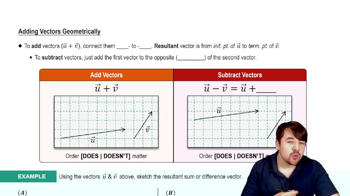
Vectors can be visualized geometrically as arrows in the plane. Subtracting vectors corresponds to adding the negative of a vector, which can be interpreted as reversing the direction of v and then adding it to u. This geometric view helps in understanding vector operations beyond algebraic manipulation.
Video consigliato:
Percorso guidato
05:29
Adding Vectors Geometrically