Ch. 7 - Applications of Trigonometry and Vectors
Lial - Trigonometry 12th Edition
Lial12th EditionTrigonometryISBN: 9780136552161, 9780135440780, 9780136881117, 9780135440827, 9780135924891Non è quello che usi tu?Cambia libro di testo
Capitolo 8, Problema 5

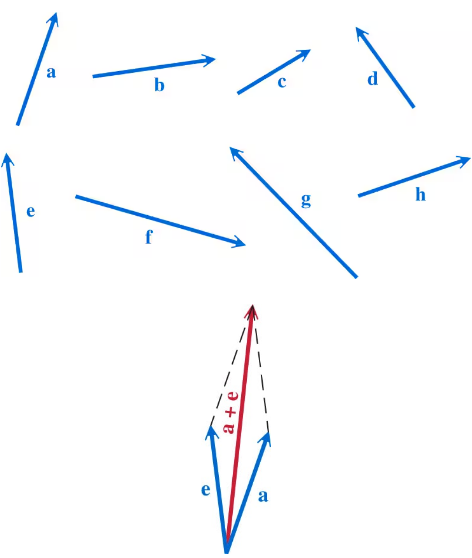
CONCEPT PREVIEW Refer to vectors a through h below. Make a copy or a sketch of each vector, and then draw a sketch to represent each of the following. For example, find a + e by placing a and e so that their initial points coincide. Then use the parallelogram rule to find the resultant, as shown in the figure on the right.


Blue vectors labeled a through h are shown, with a red vector illustrating the sum of vectors a and e using the parallelogram rule.


-b

Guida verificata passo dopo passo
1
Identify the vector \( \mathbf{b} \) from the given set of vectors. Understand its direction and magnitude based on the sketch or description provided.
To find \( -\mathbf{b} \), reverse the direction of vector \( \mathbf{b} \) while keeping its magnitude the same. This means if \( \mathbf{b} \) points in a certain direction, \( -\mathbf{b} \) points exactly opposite.
Draw the vector \( -\mathbf{b} \) starting from the origin or the same initial point as \( \mathbf{b} \), but pointing in the opposite direction.
Label the vector \( -\mathbf{b} \) clearly on your sketch to distinguish it from \( \mathbf{b} \).
Review your sketch to ensure that the length of \( -\mathbf{b} \) matches that of \( \mathbf{b} \) and that the direction is exactly reversed.

Concetti chiave

Ecco i concetti essenziali che devi comprendere per rispondere correttamente alla domanda.

Vector Addition and Subtraction

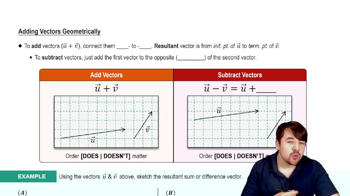
Vector addition involves combining two vectors by placing them head-to-tail and drawing the resultant vector from the start of the first to the end of the second. Subtraction, such as -b, means reversing the direction of vector b before adding it. Understanding how to add and subtract vectors graphically is essential for solving problems involving vector sums.
Video consigliato:
Percorso guidato
05:29
Adding Vectors Geometrically

Parallelogram Rule

The parallelogram rule is a geometric method to find the resultant of two vectors originating from the same point. By placing the vectors tail-to-tail, you complete a parallelogram with these vectors as adjacent sides; the diagonal of this parallelogram represents their sum. This rule helps visualize vector addition and is crucial for accurate vector sketching.
Video consigliato:
Percorso guidato
5:08
Sine, Cosine, & Tangent of 30°, 45°, & 60°

Vector Direction and Negative Vectors

A negative vector has the same magnitude as the original but points in the opposite direction. For example, -b is vector b reversed. Recognizing how to represent negative vectors graphically is important for correctly performing vector subtraction and understanding vector operations in trigonometry.
Video consigliato:
Percorso guidato
05:13
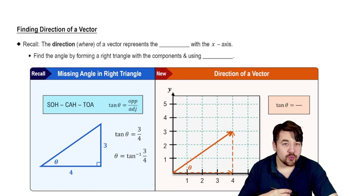
Finding Direction of a Vector