Ch. 7 - Applications of Trigonometry and Vectors
Lial - Trigonometry 12th Edition
Lial12th EditionTrigonometryISBN: 9780136552161, 9780135440780, 9780136881117, 9780135440827, 9780135924891Non è quello che usi tu?Cambia libro di testo
Capitolo 8, Problema 7

Determine the number of triangles ABC possible with the given parts.


a = 31, b = 26, B = 48°

Guida verificata passo dopo passo
1
Identify the given elements: side \(a = 31\), side \(b = 26\), and angle \(B = 48^\circ\). Note that angle \(B\) is opposite side \(b\).
Use the Law of Sines to find the possible values of angle \(A\). The Law of Sines states: \(\frac{a}{\sin A} = \frac{b}{\sin B}\). Substitute the known values to get \(\frac{31}{\sin A} = \frac{26}{\sin 48^\circ}\).
Rearrange the equation to solve for \(\sin A\): \(\sin A = \frac{31 \times \sin 48^\circ}{26}\). Calculate the right side to find the value of \(\sin A\) (do not compute the final value here).
Analyze the value of \(\sin A\) to determine the number of possible triangles: if \(\sin A > 1\), no triangle exists; if \(\sin A = 1\), exactly one right triangle exists; if \(0 < \sin A < 1\), there may be one or two possible triangles depending on the angle \(A\) and the sum of angles.
If two triangles are possible, find the second possible angle \(A' = 180^\circ - A\). Then check if the sum of angles \(A' + B\) is less than \(180^\circ\) to confirm the existence of the second triangle.

Risposta video verificata per un problema simile:

Questa soluzione video è stata consigliata dai nostri tutor come utile per risolvere questo problema.

Concetti chiave

Ecco i concetti essenziali che devi comprendere per rispondere correttamente alla domanda.

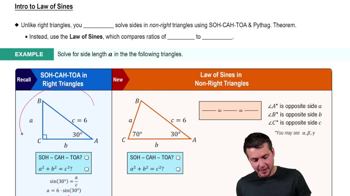
Law of Sines

The Law of Sines relates the sides and angles of a triangle through the ratio a/sin(A) = b/sin(B) = c/sin(C). It is essential for solving triangles when given two sides and an angle not included between them, allowing calculation of unknown angles or sides.
Video consigliato:
Percorso guidato
4:27
Intro to Law of Sines

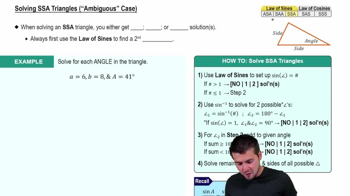
Ambiguous Case (SSA Condition)

When two sides and a non-included angle (SSA) are given, there can be zero, one, or two possible triangles. This ambiguity arises because the given angle and side lengths may correspond to different triangle configurations, requiring careful analysis to determine the number of valid solutions.
Video consigliato:
Percorso guidato
9:50
Solving SSA Triangles ("Ambiguous" Case)

Triangle Inequality and Angle Constraints

The triangle inequality states that the sum of any two sides must be greater than the third side. Additionally, angles must sum to 180°. These constraints help verify if the given measurements can form a valid triangle and limit the possible number of triangles.
Video consigliato:
Percorso guidato
5:35
30-60-90 Triangles