Ch. 7 - Applications of Trigonometry and Vectors
Lial - Trigonometry 12th Edition
Lial12th EditionTrigonometryISBN: 9780136552161, 9780135440780, 9780136881117, 9780135440827, 9780135924891Non è quello che usi tu?Cambia libro di testo
Capitolo 8, Problema 9

Determine the number of triangles ABC possible with the given parts.


c = 50, b = 61, C = 58°

Guida verificata passo dopo passo
1
Identify the given elements: side \(c = 50\), side \(b = 61\), and angle \(C = 58^\circ\). Note that angle \(C\) is opposite side \(c\).
Use the Law of Sines to find the unknown angle \(B\). The Law of Sines states: \(\frac{b}{\sin B} = \frac{c}{\sin C}\). Substitute the known values to get \(\frac{61}{\sin B} = \frac{50}{\sin 58^\circ}\).
Rearrange the equation to solve for \(\sin B\): \(\sin B = \frac{61 \times \sin 58^\circ}{50}\). Calculate this value to determine \(\sin B\) (do not find the final numeric value yet).
Analyze the value of \(\sin B\) to determine the number of possible triangles: if \(\sin B > 1\), no triangle exists; if \(\sin B = 1\), exactly one right triangle exists; if \(0 < \sin B < 1\), there may be one or two possible triangles depending on the angle \(B\) and the sum of angles.
If two triangles are possible, find the two possible values of angle \(B\) using \(B = \sin^{-1}(\sin B)\) and \(B' = 180^\circ - B\). Then check if the sum of angles \(B + C\) is less than \(180^\circ\) to confirm the validity of each triangle.

Risposta video verificata per un problema simile:

Questa soluzione video è stata consigliata dai nostri tutor come utile per risolvere questo problema.

Concetti chiave

Ecco i concetti essenziali che devi comprendere per rispondere correttamente alla domanda.

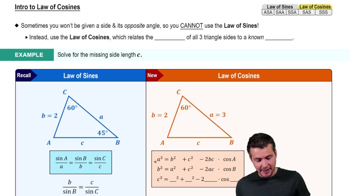
Law of Cosines

The Law of Cosines relates the lengths of sides of a triangle to the cosine of one of its angles. It is used to find an unknown side or angle when two sides and the included angle are known, or when all three sides are known. The formula is c² = a² + b² - 2ab cos(C), which helps determine missing elements in the triangle.
Video consigliato:
Percorso guidato
4:35
Intro to Law of Cosines

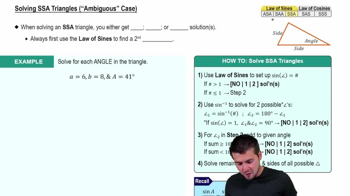
Triangle Existence and Ambiguity

Determining the number of possible triangles involves checking if the given sides and angle satisfy triangle inequality and geometric constraints. Some combinations can produce zero, one, or two triangles, especially in cases like SSA (Side-Side-Angle). Understanding these conditions helps identify if the triangle is unique or ambiguous.
Video consigliato:
Percorso guidato
9:50
Solving SSA Triangles ("Ambiguous" Case)

Angle-Side Relationships in Triangles

In any triangle, the size of an angle is directly related to the length of the opposite side. Larger angles face longer sides and vice versa. This relationship is crucial when analyzing given parts to verify if the triangle can exist and to determine the possible configurations of the triangle.
Video consigliato:
Percorso guidato
4:18
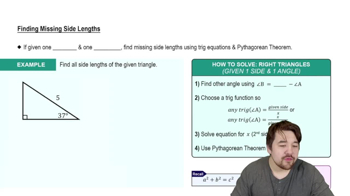
Finding Missing Side Lengths