Ch. 7 - Applications of Trigonometry and Vectors
Lial - Trigonometry 12th Edition
Lial12th EditionTrigonometryISBN: 9780136552161, 9780135440780, 9780136881117, 9780135440827, 9780135924891Non è quello che usi tu?Cambia libro di testo
Capitolo 8, Problema 78

Determine whether each pair of vectors is orthogonal.
i + 3√2j, 6i - √2j

Guida verificata passo dopo passo
1
Recall that two vectors are orthogonal if their dot product is zero. The dot product of vectors \( \mathbf{a} = a_1 \mathbf{i} + a_2 \mathbf{j} \) and \( \mathbf{b} = b_1 \mathbf{i} + b_2 \mathbf{j} \) is given by the formula: \[ \mathbf{a} \cdot \mathbf{b} = a_1 b_1 + a_2 b_2 \]
Identify the components of the given vectors. For the first vector \( \mathbf{v_1} = \mathbf{i} + 3\sqrt{2} \mathbf{j} \), the components are \( a_1 = 1 \) and \( a_2 = 3\sqrt{2} \). For the second vector \( \mathbf{v_2} = 6 \mathbf{i} - \sqrt{2} \mathbf{j} \), the components are \( b_1 = 6 \) and \( b_2 = -\sqrt{2} \).
Calculate the dot product using the components: \[ \mathbf{v_1} \cdot \mathbf{v_2} = (1)(6) + (3\sqrt{2})(-\sqrt{2}) \]
Simplify the expression by multiplying the terms: \[ (1)(6) = 6 \] and \[ (3\sqrt{2})(-\sqrt{2}) = 3 \times (-1) \times (\sqrt{2} \times \sqrt{2}) = 3 \times (-1) \times 2 = -6 \]
Add the results from the two products to find the dot product: \[ 6 + (-6) = 0 \] Since the dot product is zero, conclude that the vectors are orthogonal.

Risposta video verificata per un problema simile:

Questa soluzione video è stata consigliata dai nostri tutor come utile per risolvere questo problema.

Concetti chiave

Ecco i concetti essenziali che devi comprendere per rispondere correttamente alla domanda.

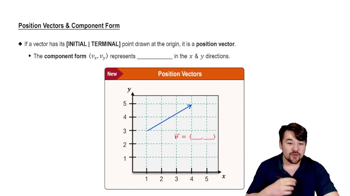
Vector Components and Representation

Vectors in two dimensions can be expressed as combinations of unit vectors i and j, representing the x and y components respectively. Understanding how to identify and write vectors in component form is essential for performing operations like dot product and checking orthogonality.
Video consigliato:
Percorso guidato
03:55
Position Vectors & Component Form

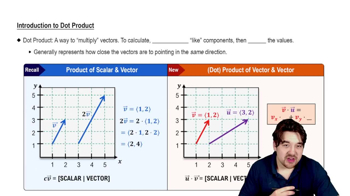
Dot Product of Vectors

The dot product is a scalar value obtained by multiplying corresponding components of two vectors and summing the results. It is calculated as (x1 * x2) + (y1 * y2) for 2D vectors, and is fundamental in determining the relationship between vectors, such as orthogonality.
Video consigliato:
Percorso guidato
05:40
Introduction to Dot Product

Orthogonality of Vectors

Two vectors are orthogonal if their dot product equals zero, meaning they are perpendicular to each other. Checking orthogonality involves computing the dot product and verifying if the result is zero, which indicates a 90-degree angle between the vectors.
Video consigliato:
Percorso guidato
03:48
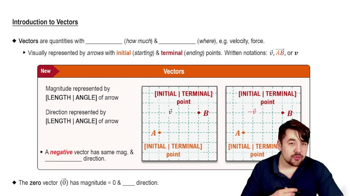
Introduction to Vectors