Ch. 7 - Applications of Trigonometry and Vectors
Lial - Trigonometry 12th Edition
Lial12th EditionTrigonometryISBN: 9780136552161, 9780135440780, 9780136881117, 9780135440827, 9780135924891Non è quello che usi tu?Cambia libro di testo
Capitolo 8, Problema 38

Find the force required to keep a 3000-lb car parked on a hill that makes an angle of 15° with the horizontal.

Guida verificata passo dopo passo
1
Identify the forces acting on the car: the weight of the car acts vertically downward, and the force required to keep the car parked acts along the hill's surface, opposing the component of the weight pulling the car downhill.
Resolve the weight of the car into two components relative to the hill: one perpendicular to the hill's surface and one parallel to the hill's surface. The component parallel to the hill is responsible for the car's tendency to slide down.
Use the formula for the component of the weight parallel to the incline: \(F = W \times \sin(\theta)\), where \(W\) is the weight of the car (3000 lb) and \(\theta\) is the angle of the hill (15°).
Substitute the given values into the formula: \(F = 3000 \times \sin(15^\circ)\).
Calculate \(\sin(15^\circ)\) using a calculator or trigonometric table, then multiply by 3000 to find the force required to keep the car parked on the hill.

Risposta video verificata per un problema simile:

Questa soluzione video è stata consigliata dai nostri tutor come utile per risolvere questo problema.

Concetti chiave

Ecco i concetti essenziali che devi comprendere per rispondere correttamente alla domanda.

Resolving Forces on an Inclined Plane

When an object rests on a slope, its weight can be split into components parallel and perpendicular to the incline. The parallel component causes the object to slide down, calculated as weight times sine of the angle, while the perpendicular component presses into the surface.
Video consigliato:

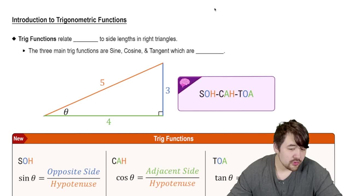
Trigonometric Functions in Force Analysis

Sine and cosine functions relate the angle of the incline to the force components. Specifically, sine of the angle gives the ratio of the opposite side (parallel force) to the hypotenuse (weight), essential for determining the force needed to counteract sliding.
Video consigliato:
Percorso guidato
6:04
Introduction to Trigonometric Functions

Equilibrium and Static Friction

To keep the car stationary, the applied force must balance the downhill component of weight, achieving equilibrium. Understanding static friction or the required force to prevent motion is key, as it counteracts the tendency to slide down the hill.
Video consigliato:
Percorso guidato
4:02
Solving Linear Equations with Fractions
Pratica correlata
Domanda del libro di testo

The bearing of a lighthouse from a ship was found to be N 37° E. After the ship sailed 2.5 mi due south, the new bearing was N 25° E. Find the distance between the ship and the lighthouse at each location.

1450
views

Domanda del libro di testo

To build the pyramids in Egypt, it is believed that giant causeways were constructed to transport the building materials to the site. One such causeway is said to have been 3000 ft long, with a slope of about 2.3°. How much force would be required to hold a 60-ton monolith on this causeway?


<IMAGE>

918
views
1
rank
Domanda del libro di testo

Use the law of sines to prove that each statement is true for any triangle ABC, with corresponding sides a, b, and c.


(a - b)/(a + b) = (sin A - sin B)/(sin A + sin B)

837
views
Domanda del libro di testo

Given u = 〈-2, 5〉 and v = 〈4, 3〉, find each of the following.

- 2u + 4v

670
views
Domanda del libro di testo

A balloonist is directly above a straight road 1.5 mi long that joins two villages. She finds that the town closer to her is at an angle of depression of 35°, and the farther town is at an angle of depression of 31°. How high above the ground is the balloon? 


<IMAGE>

629
views
Domanda del libro di testo

Standing on one bank of a river flowing north, Mark notices a tree on the opposite bank at a bearing of 115.45°. Lisa is on the same bank as Mark, but 428.3 m away. She notices that the bearing of the tree is 45.47°. The two banks are parallel. What is the distance across the river?

758
views