Ch. 7 - Applications of Trigonometry and Vectors
Lial - Trigonometry 12th Edition
Lial12th EditionTrigonometryISBN: 9780136552161, 9780135440780, 9780136881117, 9780135440827, 9780135924891Non è quello che usi tu?Cambia libro di testo
Capitolo 8, Problema 23

Use the parallelogram rule to find the magnitude of the resultant force for the two forces shown in each figure. Round answers to the nearest tenth.
<IMAGE>

Guida verificata passo dopo passo
1
Identify the magnitudes of the two forces and the angle between them from the figure. Let's denote the forces as \( F_1 \) and \( F_2 \), and the angle between them as \( \theta \).
Recall the parallelogram rule states that the magnitude of the resultant force \( R \) can be found using the formula: \[ R = \sqrt{F_1^2 + F_2^2 + 2 F_1 F_2 \cos(\theta)} \]
Substitute the known values of \( F_1 \), \( F_2 \), and \( \theta \) into the formula. Make sure the angle \( \theta \) is in degrees or radians consistent with your calculator settings.
Calculate the value inside the square root step-by-step: first square each force, then calculate the product \( 2 F_1 F_2 \cos(\theta) \), and finally sum all these terms.
Take the square root of the sum to find the magnitude of the resultant force \( R \). Round your answer to the nearest tenth as requested.

Risposta video verificata per un problema simile:

Questa soluzione video è stata consigliata dai nostri tutor come utile per risolvere questo problema.

Concetti chiave

Ecco i concetti essenziali che devi comprendere per rispondere correttamente alla domanda.

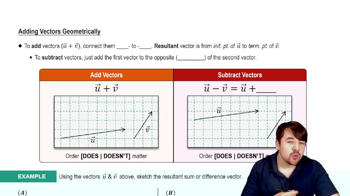
Parallelogram Rule for Vector Addition

The parallelogram rule is a geometric method to add two vectors. By placing the vectors tail-to-tail, a parallelogram is formed, and the diagonal from the common tail point represents the resultant vector. The magnitude and direction of this diagonal give the combined effect of the two forces.
Video consigliato:
Percorso guidato
05:29
Adding Vectors Geometrically

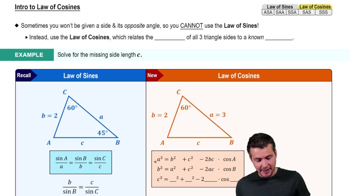
Vector Magnitude Calculation Using Law of Cosines

When two vectors form an angle, the magnitude of their resultant can be found using the law of cosines: R = √(A² + B² + 2AB cos θ), where A and B are magnitudes of the vectors and θ is the angle between them. This formula helps compute the length of the diagonal in the parallelogram.
Video consigliato:
Percorso guidato
4:35
Intro to Law of Cosines

Rounding and Precision in Final Answers

After calculating the resultant magnitude, it is important to round the answer appropriately, as specified (to the nearest tenth). Proper rounding ensures clarity and consistency in reporting results, especially in applied problems involving measurements.
Video consigliato:
Percorso guidato
2:22
Cardioids Example 1