Ch. 7 - Applications of Trigonometry and Vectors
Lial - Trigonometry 12th Edition
Lial12th EditionTrigonometryISBN: 9780136552161, 9780135440780, 9780136881117, 9780135440827, 9780135924891Non è quello che usi tu?Cambia libro di testo
Capitolo 8, Problema 16

Vector v has the given direction angle and magnitude. Find the horizontal and vertical components.
θ = 50°, |v| = 26

Guida verificata passo dopo passo
1
Identify the given information: the direction angle \( \theta = 50^\circ \) and the magnitude of the vector \( |v| = 26 \).
Recall that the horizontal component (\( v_x \)) of a vector can be found using the formula \( v_x = |v| \cdot \cos(\theta) \).
Recall that the vertical component (\( v_y \)) of a vector can be found using the formula \( v_y = |v| \cdot \sin(\theta) \).
Substitute the given values into the formulas: \( v_x = 26 \cdot \cos(50^\circ) \) and \( v_y = 26 \cdot \sin(50^\circ) \).
Calculate the cosine and sine of \( 50^\circ \) using a calculator or trigonometric tables, then multiply by 26 to find the components.

Risposta video verificata per un problema simile:

Questa soluzione video è stata consigliata dai nostri tutor come utile per risolvere questo problema.

Concetti chiave

Ecco i concetti essenziali che devi comprendere per rispondere correttamente alla domanda.

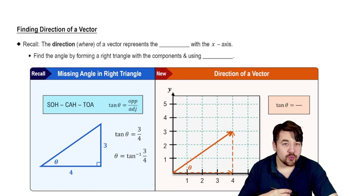
Direction Angle of a Vector

The direction angle θ of a vector is the angle it makes with the positive x-axis, measured counterclockwise. It determines the vector's orientation in the plane and is essential for decomposing the vector into components along the horizontal and vertical axes.
Video consigliato:
Percorso guidato
05:13
Finding Direction of a Vector

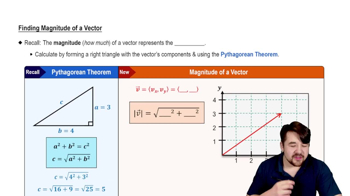
Magnitude of a Vector

The magnitude |v| of a vector represents its length or size. It is a scalar quantity that, combined with the direction angle, fully describes the vector. Knowing the magnitude allows calculation of the vector's components using trigonometric functions.
Video consigliato:
Percorso guidato
04:44
Finding Magnitude of a Vector

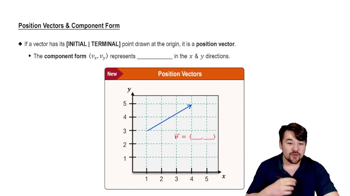
Resolving a Vector into Components

A vector can be broken down into horizontal (x) and vertical (y) components using trigonometry: x = |v| cos(θ) and y = |v| sin(θ). This process simplifies vector analysis by expressing it in terms of perpendicular directions.
Video consigliato:
Percorso guidato
03:55
Position Vectors & Component Form