Ch. 8 - Complex Numbers, Polar Equations, and Parametric Equations
Lial - Trigonometry 12th Edition
Lial12th EditionTrigonometryISBN: 9780136552161, 9780135440780, 9780136881117, 9780135440827, 9780135924891Non è quello che usi tu?Cambia libro di testo
Capitolo 9, Problema 46

Match each equation with its polar graph from choices A–D.
r = 2/(cosθ + sinθ)

Guida verificata passo dopo passo
1
Recognize that the given equation is in polar form: \(r = \frac{2}{\cos\theta + \sin\theta}\), where \(r\) is the radius and \(\theta\) is the angle.
Multiply both sides of the equation by the denominator to eliminate the fraction: \(r(\cos\theta + \sin\theta) = 2\).
Recall that in polar coordinates, \(x = r\cos\theta\) and \(y = r\sin\theta\). Substitute these into the equation to rewrite it in Cartesian form: \(x + y = 2\).
Interpret the Cartesian equation \(x + y = 2\) as a straight line in the \(xy\)-plane. This means the polar graph corresponds to a line, but expressed in polar coordinates.
Use this understanding to match the given polar equation with the correct graph among choices A–D, identifying the graph that represents the line \(x + y = 2\).

Risposta video verificata per un problema simile:

Questa soluzione video è stata consigliata dai nostri tutor come utile per risolvere questo problema.
Durata del video:
6m

Concetti chiave

Ecco i concetti essenziali che devi comprendere per rispondere correttamente alla domanda.

Polar Coordinates and Graphing

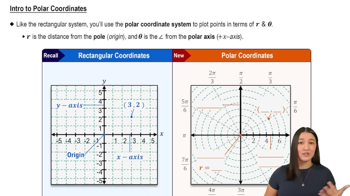
Polar coordinates represent points using a radius r and an angle θ from the positive x-axis. Understanding how to plot equations in polar form is essential, as the graph is drawn by varying θ and calculating corresponding r values, which can produce curves like circles, lines, or more complex shapes.
Video consigliato:
Percorso guidato
05:32
Intro to Polar Coordinates

Conversion Between Polar and Cartesian Coordinates

Converting polar equations to Cartesian form (x = r cosθ, y = r sinθ) helps analyze and identify the graph type. For example, rewriting r = 2/(cosθ + sinθ) in terms of x and y can reveal the geometric nature of the curve, making it easier to match with given graph options.
Video consigliato:
Percorso guidato
05:32
Intro to Polar Coordinates

Trigonometric Identities and Manipulation

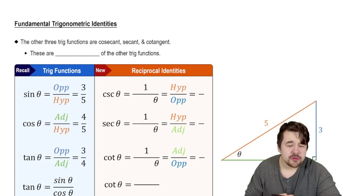
Using trigonometric identities, such as expressing cosθ + sinθ in a simplified form, aids in transforming and understanding the equation. Recognizing patterns or applying identities can clarify the shape and properties of the polar graph, facilitating accurate matching with the correct graph.
Video consigliato:
Percorso guidato
5:32
Fundamental Trigonometric Identities