Ch. R - Algebra Review
Lial - Trigonometry 12th Edition
Lial12th EditionTrigonometryISBN: 9780136552161, 9780135440780, 9780136881117, 9780135440827, 9780135924891Non è quello che usi tu?Cambia libro di testo
Capitolo 1, Problema 27

Concept Check Graph the points on a coordinate system and identify the quadrant or axis for each point. (4.5, 7)

Guida verificata passo dopo passo
1
Start by understanding the coordinate system: the horizontal axis is the x-axis and the vertical axis is the y-axis.
Locate the x-coordinate of the point, which is 4.5. Move 4.5 units to the right from the origin (0,0) along the x-axis because it is positive.
Next, locate the y-coordinate of the point, which is 7. From the position at x = 4.5, move 7 units upward along the y-axis because it is positive.
Mark the point where these two movements intersect on the coordinate plane. This is the point (4.5, 7).
Determine the quadrant: since both x and y are positive, the point lies in Quadrant I.

Risposta video verificata per un problema simile:

Questa soluzione video è stata consigliata dai nostri tutor come utile per risolvere questo problema.
Durata del video:
1m

Concetti chiave

Ecco i concetti essenziali che devi comprendere per rispondere correttamente alla domanda.

Coordinate Plane and Axes

The coordinate plane consists of two perpendicular lines called axes: the x-axis (horizontal) and the y-axis (vertical). Points are represented as ordered pairs (x, y), where x indicates the horizontal position and y indicates the vertical position relative to the origin (0,0).
Video consigliato:
Percorso guidato
05:32
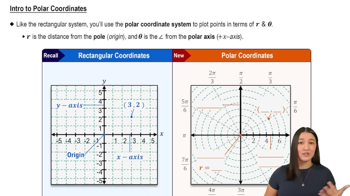
Intro to Polar Coordinates

Plotting Points

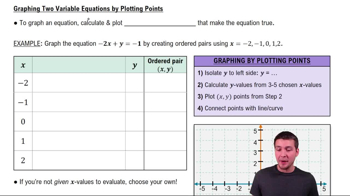
To plot a point like (4.5, 7), start at the origin, move 4.5 units along the x-axis, then move 7 units parallel to the y-axis. This locates the exact position of the point on the coordinate plane.
Video consigliato:
Percorso guidato
4:29
Graphing Two Variable Equations by Plotting Points

Quadrants of the Coordinate Plane

The coordinate plane is divided into four quadrants based on the signs of x and y values: Quadrant I (+, +), Quadrant II (-, +), Quadrant III (-, -), and Quadrant IV (+, -). Identifying the quadrant helps understand the point's location relative to the axes.
Video consigliato:
Percorso guidato
6:36
Quadratic Formula