Ch. R - Algebra Review
Lial - Trigonometry 12th Edition
Lial12th EditionTrigonometryISBN: 9780136552161, 9780135440780, 9780136881117, 9780135440827, 9780135924891Non è quello che usi tu?Cambia libro di testo
Capitolo 1, Problema 81

Determine the intervals of the domain over which each function is continuous. See Example 9.

Guida verificata passo dopo passo
1
Identify the given function and its domain. Understanding the type of function (polynomial, rational, trigonometric, piecewise, etc.) is crucial because continuity depends on the function's nature and domain restrictions.
Recall that polynomial and trigonometric functions are continuous everywhere on their domains, while rational functions may have discontinuities where the denominator is zero.
For rational functions, find the values of the variable that make the denominator zero by solving the equation where the denominator equals zero. These points are potential discontinuities.
For piecewise functions, check the continuity at the boundary points between pieces by evaluating the left-hand limit, right-hand limit, and the function value at those points to ensure they are equal.
Combine all the information to write the intervals where the function is continuous, excluding points where discontinuities occur (such as zeros of denominators or jump points in piecewise functions).

Risposta video verificata per un problema simile:

Questa soluzione video è stata consigliata dai nostri tutor come utile per risolvere questo problema.
Durata del video:
2m

Concetti chiave

Ecco i concetti essenziali che devi comprendere per rispondere correttamente alla domanda.

Continuity of a Function

A function is continuous at a point if the limit of the function as it approaches that point equals the function's value there. For trigonometric functions, continuity generally holds except at points where the function is undefined, such as vertical asymptotes.
Video consigliato:
Percorso guidato
5:57
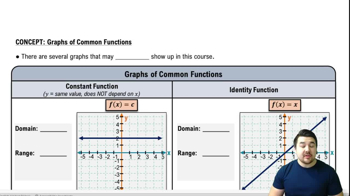
Graphs of Common Functions

Domain of Trigonometric Functions

The domain of a trigonometric function includes all input values for which the function is defined. For example, sine and cosine are defined for all real numbers, while tangent and secant are undefined where cosine is zero, causing discontinuities.
Video consigliato:
Percorso guidato
3:43
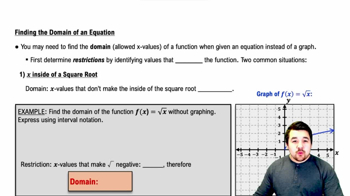
Finding the Domain of an Equation

Identifying Discontinuities

Discontinuities occur where a function is not defined or where limits do not match function values. In trigonometry, these often arise at points causing division by zero, such as vertical asymptotes in tangent or cotangent functions, which segment the domain into continuous intervals.
Video consigliato:
Percorso guidato
3:47
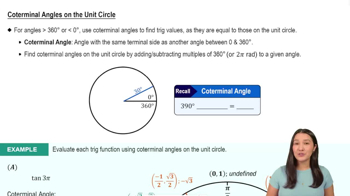
Coterminal Angles on the Unit Circle