Ch. R - Algebra Review
Lial - Trigonometry 12th Edition
Lial12th EditionTrigonometryISBN: 9780136552161, 9780135440780, 9780136881117, 9780135440827, 9780135924891Non è quello che usi tu?Cambia libro di testo
Capitolo 1, Problema R.2.71

Evaluate each expression. See Example 4. -2⁴

Guida verificata passo dopo passo
1
Identify the expression to evaluate: \(-2^4\).
Recall the order of operations (PEMDAS/BODMAS): exponents are evaluated before multiplication or negation.
Evaluate the exponent first: calculate \$2^4$, which means \(2 \times 2 \times 2 \times 2\).
After finding \$2^4$, apply the negative sign in front of the result, since the negative sign is not inside the exponentiation.
Write the final expression as \(- (2^4)\) and simplify accordingly.

Risposta video verificata per un problema simile:

Questa soluzione video è stata consigliata dai nostri tutor come utile per risolvere questo problema.
Durata del video:
1m

Concetti chiave

Ecco i concetti essenziali che devi comprendere per rispondere correttamente alla domanda.

Order of Operations (PEMDAS)

The order of operations dictates the sequence in which mathematical operations are performed: Parentheses, Exponents, Multiplication and Division (left to right), Addition and Subtraction (left to right). This ensures consistent and correct evaluation of expressions.
Video consigliato:
Percorso guidato
04:12
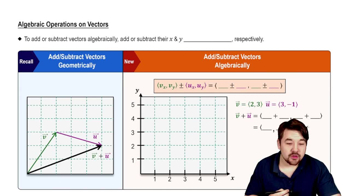
Algebraic Operations on Vectors

Exponents and Powers

An exponent indicates how many times a base number is multiplied by itself. For example, 4⁴ means 4 × 4 × 4 × 4. Understanding how to compute powers is essential for evaluating expressions involving exponents.
Video consigliato:
Percorso guidato
03:05
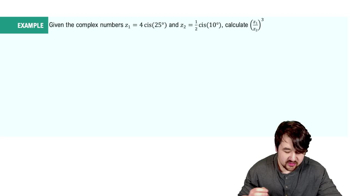
Powers Of Complex Numbers In Polar Form (DeMoivre's Theorem) Example 1

Negative Signs and Exponents

A negative sign before a base with an exponent can change the result depending on parentheses. For example, -2⁴ means the negative of 2⁴, which is -16, while (-2)⁴ means (-2) multiplied four times, resulting in 16. Recognizing this distinction is crucial.
Video consigliato:
Percorso guidato
4:28
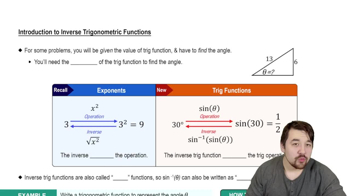
Introduction to Inverse Trig Functions