Ch. R - Algebra Review
Lial - Trigonometry 12th Edition
Lial12th EditionTrigonometryISBN: 9780136552161, 9780135440780, 9780136881117, 9780135440827, 9780135924891Non è quello che usi tu?Cambia libro di testo
Capitolo 1, Problema 89

Factor each polynomial completely. See Example 6. 8t³ + 125

Guida verificata passo dopo passo
1
Recognize that the polynomial \(8t^{3} + 125\) is a sum of cubes because \(8t^{3} = (2t)^{3}\) and \(125 = 5^{3}\).
Recall the sum of cubes factoring formula: $a^{3} + b^{3} = (a + b)(a^{2} - ab + b^{2})$.
Identify \(a = 2t\) and \(b = 5\) in the expression \(8t^{3} + 125\).
Apply the formula: write the factorization as \((2t + 5)((2t)^{2} - (2t)(5) + 5^{2})\).
Simplify the terms inside the second parenthesis to get \((2t + 5)(4t^{2} - 10t + 25)\).

Risposta video verificata per un problema simile:

Questa soluzione video è stata consigliata dai nostri tutor come utile per risolvere questo problema.
Durata del video:
4m

Concetti chiave

Ecco i concetti essenziali che devi comprendere per rispondere correttamente alla domanda.

Sum of Cubes Formula

The sum of cubes formula states that a³ + b³ = (a + b)(a² - ab + b²). It is used to factor expressions where two terms are both perfect cubes added together. Recognizing 8t³ and 125 as cubes (2t)³ and 5³ allows applying this formula to factor the polynomial.
Video consigliato:
Percorso guidato
2:25
Verifying Identities with Sum and Difference Formulas

Identifying Perfect Cubes

A perfect cube is a number or expression raised to the third power, such as 8 = 2³ or t³. Identifying each term as a perfect cube is essential before applying the sum or difference of cubes formulas. This step ensures the correct factorization method is used.
Video consigliato:
Percorso guidato
6:50
Convert Equations from Polar to Rectangular

Polynomial Factoring Techniques

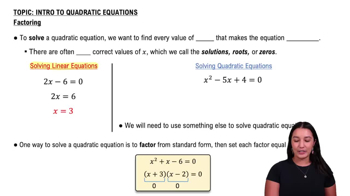
Factoring polynomials involves rewriting them as products of simpler polynomials. Techniques include factoring out common factors, grouping, and special formulas like sum/difference of cubes. Understanding these methods helps break down complex expressions into factors.
Video consigliato: