Ch. R - Algebra Review
Lial - Trigonometry 12th Edition
Lial12th EditionTrigonometryISBN: 9780136552161, 9780135440780, 9780136881117, 9780135440827, 9780135924891Non è quello che usi tu?Cambia libro di testo
Capitolo 1, Problema 1

Fill in the blank(s) to correctly complete each sentence.
To graph the function ƒ(x) = x² - 3, shift the graph of y = x² down ___ units.

Guida verificata passo dopo passo
1
Identify the base function and the transformation applied. The base function here is \(y = x^{2}\), which is a standard parabola centered at the origin.
Recognize that the function \(ƒ(x) = x^{2} - 3\) is a vertical shift of the base function \(y = x^{2}\).
Understand that subtracting a constant from the function, as in \(x^{2} - 3\), shifts the graph vertically downward by that constant value.
Therefore, the graph of \(ƒ(x) = x^{2} - 3\) is the graph of \(y = x^{2}\) shifted down by 3 units.
Fill in the blank with the number 3, indicating the downward shift in units.

Risposta video verificata per un problema simile:

Questa soluzione video è stata consigliata dai nostri tutor come utile per risolvere questo problema.
Durata del video:
1m

Concetti chiave

Ecco i concetti essenziali che devi comprendere per rispondere correttamente alla domanda.

Graphing Quadratic Functions

Graphing quadratic functions involves plotting parabolas based on the equation y = ax² + bx + c. The basic shape is determined by the coefficient a, while the position is influenced by b and c. Understanding how changes in the equation affect the graph is essential for accurate plotting.
Video consigliato:
Percorso guidato
6:36
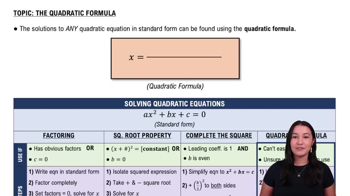
Quadratic Formula

Vertical Shifts of Graphs

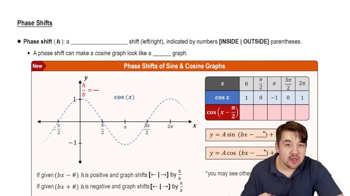
A vertical shift moves the entire graph up or down without changing its shape. Adding or subtracting a constant k to the function, as in y = f(x) + k, shifts the graph vertically by k units. Positive k shifts the graph up, while negative k shifts it down.
Video consigliato:

Interpreting Function Transformations

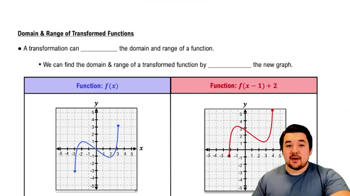
Function transformations describe how changes to the equation affect the graph's position and shape. Recognizing these transformations, such as shifts, stretches, and reflections, helps in quickly sketching or understanding the graph of modified functions.
Video consigliato:
Percorso guidato
4:22
Domain and Range of Function Transformations