Ch. R - Algebra Review
Lial - Trigonometry 12th Edition
Lial12th EditionTrigonometryISBN: 9780136552161, 9780135440780, 9780136881117, 9780135440827, 9780135924891Non è quello che usi tu?Cambia libro di testo
Capitolo 1, Problema 37

Find each root. See Example 3. -∛512

Guida verificata passo dopo passo
1
Recognize that the problem asks for the cube root of -512, which means finding a number \( x \) such that \( x^3 = -512 \).
Recall that the cube root function can be applied to negative numbers because \( (-a)^3 = -a^3 \). So, \( \sqrt[3]{-512} = -\sqrt[3]{512} \).
Focus on finding \( \sqrt[3]{512} \). Express 512 as a power of a smaller number, for example, check if 512 is a power of 2: \( 512 = 2^9 \).
Use the property of roots and exponents: \( \sqrt[3]{2^9} = 2^{9/3} = 2^3 \).
Calculate \( 2^3 \) to find the cube root of 512, then apply the negative sign to get the cube root of -512.

Risposta video verificata per un problema simile:

Questa soluzione video è stata consigliata dai nostri tutor come utile per risolvere questo problema.
Durata del video:
1m

Concetti chiave

Ecco i concetti essenziali che devi comprendere per rispondere correttamente alla domanda.

Cube Roots

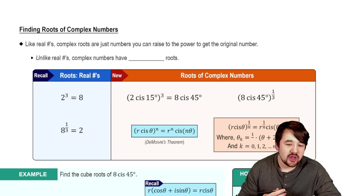
The cube root of a number is a value that, when multiplied by itself three times, gives the original number. For example, the cube root of 27 is 3 because 3 × 3 × 3 = 27. Cube roots can be positive or negative depending on the original number.
Video consigliato:

Handling Negative Radicals

When taking the cube root of a negative number, the result is also negative because a negative number multiplied three times remains negative. For instance, the cube root of -512 is -8 since (-8)³ = -512. This differs from even roots, where negative inputs are not real.
Video consigliato:
Percorso guidato
03:11
Algebraic Operations on Vectors Example 1

Prime Factorization for Roots

Prime factorization breaks a number into its prime components, making it easier to find roots. For example, 512 = 2⁹, so the cube root of 512 is 2³ = 8. Using prime factorization simplifies root extraction by grouping factors according to the root's degree.
Video consigliato: