Ch. R - Algebra Review
Lial - Trigonometry 12th Edition
Lial12th EditionTrigonometryISBN: 9780136552161, 9780135440780, 9780136881117, 9780135440827, 9780135924891Non è quello che usi tu?Cambia libro di testo
Capitolo 1, Problema 62

For each function, find (a) ƒ(2) and (b) ƒ(-1). See Example 7. ƒ = {(2, 5), (3, 9), (-1, 11), (5, 3)}

Guida verificata passo dopo passo
1
Understand that the function ƒ is given as a set of ordered pairs, where the first element of each pair is the input (x) and the second element is the output (ƒ(x)).
To find ƒ(2), look for the ordered pair where the first element is 2. The second element of that pair will be the value of ƒ(2).
To find ƒ(-1), look for the ordered pair where the first element is -1. The second element of that pair will be the value of ƒ(-1).
Write down the values you found for ƒ(2) and ƒ(-1) explicitly, matching the function's output to the given inputs.
Verify that the inputs 2 and -1 exist in the function's domain (the set of first elements in the ordered pairs) to ensure the function is defined at those points.

Risposta video verificata per un problema simile:

Questa soluzione video è stata consigliata dai nostri tutor come utile per risolvere questo problema.
Durata del video:
1m

Concetti chiave

Ecco i concetti essenziali che devi comprendere per rispondere correttamente alla domanda.

Function Notation and Evaluation

Function notation, written as ƒ(x), represents the output value of a function for a given input x. Evaluating ƒ(a) means finding the output corresponding to the input a by locating the pair (a, ƒ(a)) in the function's definition or graph.
Video consigliato:

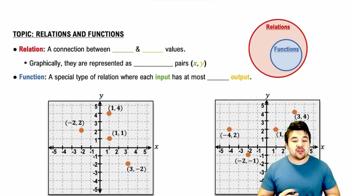
Set of Ordered Pairs as a Function

A function can be defined as a set of ordered pairs where each input (first element) is paired with exactly one output (second element). Understanding this helps in directly identifying the output values for given inputs by searching the pairs.
Video consigliato:
Percorso guidato
5:20
Introduction to Relations and Functions

Domain and Range

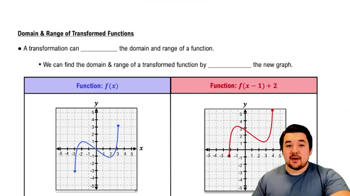
The domain of a function is the set of all possible input values, while the range is the set of all possible outputs. Knowing the domain ensures that the input values you evaluate, like 2 or -1, are valid inputs for the function.
Video consigliato:
Percorso guidato
4:22
Domain and Range of Function Transformations