
Ch. R - Algebra Review
Lial - Trigonometry 12th Edition
Lial12th EditionTrigonometryISBN: 9780136552161, 9780135440780, 9780136881117, 9780135440827, 9780135924891Non è quello che usi tu?Cambia libro di testo
Capitolo 1, Problema 147

For Individual or Group Work (Exercises 147 – 150)In calculus, it is sometimes desirable to rationalize a numerator. To do this, we multiply the numerator and the denominator by the conjugate of the numerator. For example, (6 - √2)/4 = (6 - √2)/4 × (6 + √2)/(6 + √2) = (36 - 2)/(4(6 + √2)) = 34/(4(6 + √2)) = 17/(2(6 + √2)) = 17/(6 + √2). Rationalize each numerator. (6 - √3)/8

Guida verificata passo dopo passo
1
Identify the expression to rationalize: \(\frac{6 - \sqrt{3}}{8}\). The numerator is \(6 - \sqrt{3}\), which contains a square root that we want to eliminate by rationalizing.
Find the conjugate of the numerator. The conjugate of \(6 - \sqrt{3}\) is \(6 + \sqrt{3}\). This is because conjugates have the same terms but opposite signs between them.
Multiply both the numerator and the denominator by the conjugate of the numerator to keep the expression equivalent. This gives: \(\frac{6 - \sqrt{3}}{8} \times \frac{6 + \sqrt{3}}{6 + \sqrt{3}}\).
Use the difference of squares formula to simplify the numerator: \((a - b)(a + b) = a^2 - b^2\). Here, \(a = 6\) and \(b = \sqrt{3}\), so the numerator becomes \(6^2 - (\sqrt{3})^2\).
Simplify the numerator and write the new expression as \(\frac{36 - 3}{8(6 + \sqrt{3})}\). This is the rationalized form with the numerator free of square roots.

Risposta video verificata per un problema simile:

Questa soluzione video è stata consigliata dai nostri tutor come utile per risolvere questo problema.
Durata del video:
4m

Concetti chiave

Ecco i concetti essenziali che devi comprendere per rispondere correttamente alla domanda.

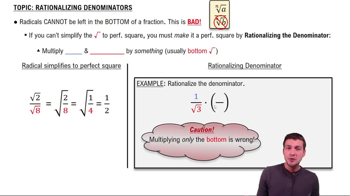
Rationalizing the Numerator

Rationalizing the numerator involves eliminating any irrational numbers (like square roots) from the numerator of a fraction. This is done by multiplying both numerator and denominator by the conjugate of the numerator, which helps simplify expressions and makes further calculations easier.
Video consigliato:
Percorso guidato
2:58
Rationalizing Denominators

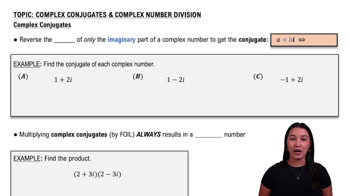
Conjugates in Algebra

The conjugate of a binomial expression a + √b is a - √b, and vice versa. Multiplying conjugates results in a difference of squares, which removes the square root terms. This property is essential for rationalizing expressions containing radicals.
Video consigliato:
Percorso guidato
5:33
Complex Conjugates

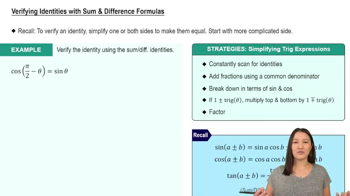
Difference of Squares Formula

The difference of squares formula states that (x + y)(x - y) = x² - y². When applied to conjugates involving square roots, it eliminates the radical by converting it into a rational number, simplifying the expression significantly.
Video consigliato:
Percorso guidato
2:25
Verifying Identities with Sum and Difference Formulas